All-on-Four Dental Implant Rehabilitation for a 75-Year-Old Long-Term Denture Wearer
Patient's Name
Mr. A. Kumar (Name has been changed for privacy concern)
Gender
Male
Clinic/ Hospital Name
Jaydev Dental Clinic, Jubilee Hills, Hyderabad
Patient's Age:
75
Patient Background
A 75 year old patient came to Dr. Jaydev Dental, Hyderabad, after wearing dentures for 10 to 15 years. He wanted a permanent solution instead of his removable dentures that never fit properly. His dentures made eating uncomfortable and he wasn’t happy with how they looked. Years of wearing dentures had caused his jawbone to shrink and his bite to collapse, which made planning his treatment more challenging.
Chief Complaint
The patient told us about his main problems:
- He was tired of wearing dentures after more than 10 years
- His dentures kept moving around when he ate or talked
- He couldn’t chew his food properly
- His smile didn’t look good, which affected his confidence
What he really wanted was to eat comfortably again without worrying about his dentures falling out or causing embarrassment.
Clinical Examination and Diagnosis
When we examined him, we found:
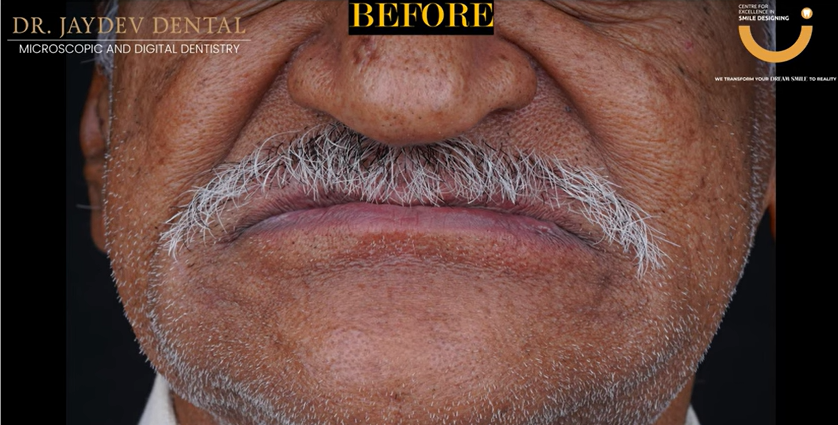
- He had no teeth left in either jaw
- His bite height had decreased from years of denture wear
- His jawbone had shrunk significantly, especially in the upper jaw
Because of his age and the bone loss, we recommended a 3D CBCT scan. This helped us see exactly how much bone he had and plan the best approach for his implants.
Treatment Plan
We discussed three options with the patient:
Option 1: Sinus lift surgery with regular implants in the back of the upper jaw
Option 2: Zygomatic implants that anchor into the cheekbone
Option 3: All-on-Four implants using angled implants to avoid the sinus
The patient did not want major surgery, such as sinus lifts or zygomatic implants, because these procedures are more complex and require longer recovery. He chose the All-on-Four approach for both jaws; it is less invasive, has proven efficacy, and is more cost-effective.
Digital Planning
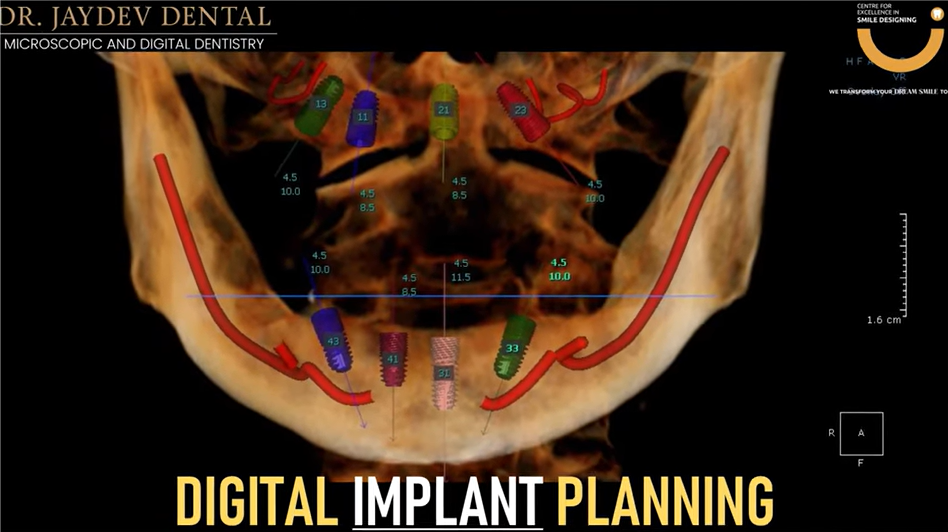
We talked with the patient about how many teeth he wanted. He said 20 teeth total (10 on top, 10 on bottom) would work well for him instead of the usual 28. This made cleaning easier and gave a nice balanced look.
Using 3D planning software, we mapped out:
- Where to place four implants in the lower jaw
- Where to place four to six implants in the upper jaw (extra ones as backup in case any failed)
- The best angles for the back implants to use the available bone and avoid the sinuses
This careful planning helped make the surgery more precise and reduced risks.
Making the Final Teeth
After 3 months, we started making his permanent teeth. Here’s how:
- Digital scans: We took 3D scans of his implants and gums. These were much more accurate than old-style impressions.
- Framework design: We designed the supporting structure digitally to fit perfectly and spread the chewing forces evenly.
- Material: We made high-quality ceramic teeth that look natural and last long. The framework fits precisely on the implants with no stress.
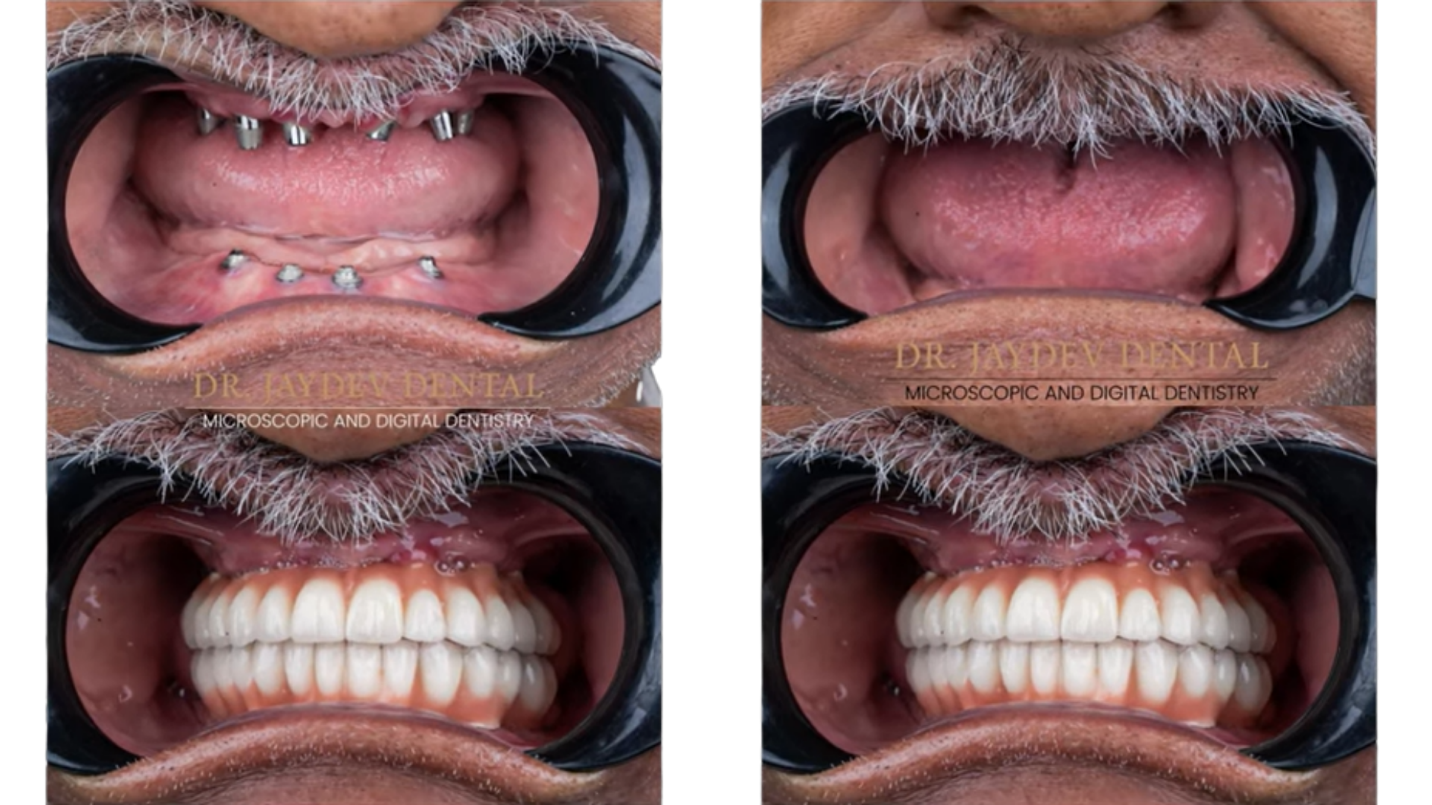
The finished teeth gave him a full, natural-looking smile.
The Surgery
A team of specialists performed the surgery:
- Implant specialist
- Prosthodontist
- Anesthesiologist
- Critical care specialist
Having this team made sure the patient stayed safe during the procedure, especially given his age.
Lower jaw: We placed four implants with special connectors (multi-unit abutments) to hold the teeth.
Upper jaw: We placed six implants instead of four. This gave us extra security – if one implant had a problem, the other five could still support all the teeth.
The surgery went smoothly with no complications.
Recovery and Healing
After surgery, we gave the patient a temporary denture to wear for the first 7-10 days.
His recovery instructions were:
- Eat only soft foods
- Take prescribed antibiotics and pain medication
- Keep his mouth very clean
- Avoid hard physical activity
The implants needed 3 months to fully bond with the bone. We saw him regularly during this period to ensure everything was healing well.
Clinical Examination and Diagnosis
When we examined him, we found:
- He had no teeth left in either jaw
- His bite height had decreased from years of denture wear
- His jawbone had shrunk significantly, especially in the upper jaw
Because of his age and the bone loss, we recommended a 3D CBCT scan. This helped us see exactly how much bone he had and plan the best approach for his implants.
CBCT Scan Results
The scan showed us:
- Lower jaw: There was enough bone to place implants without needing bone grafts.
- Upper jaw: The bone had shrunk a lot. Only the front area had enough bone. The sinus cavities had expanded into the back areas where teeth used to be. Normally, this would need sinus lift surgery or special zygomatic implants.
Results
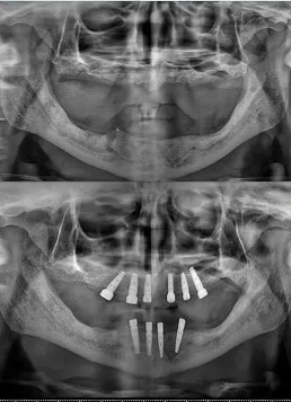
The whole treatment took about 3-4 months from start to finish. The change was remarkable – from someone struggling with dentures to having fixed teeth and renewed confidence.
Better function: He can now eat all types of food without any problems.
Better appearance: His new teeth look natural and make him look younger.
Better quality of life: He feels more confident and happy with his smile.
The patient and his family were extremely happy with the results. He can now enjoy his meals and smile confidently again.