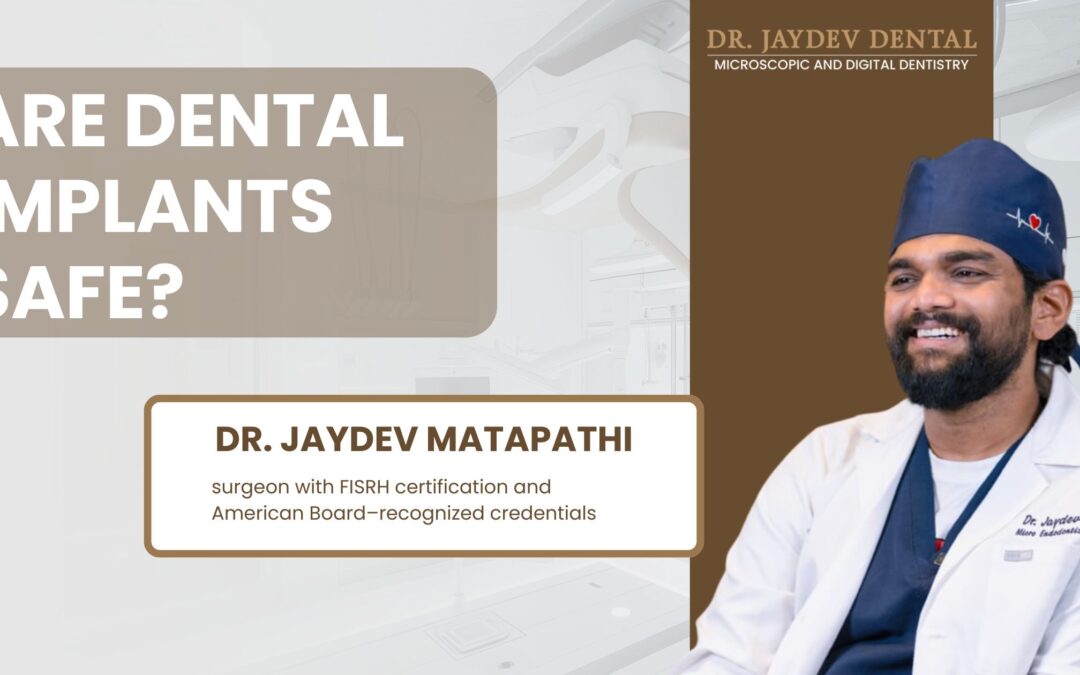
Dental implants are considered very safe and highly effective, with a 95% to 98% success rate. Made of biocompatible titanium, they offer a long-term, stable solution for missing teeth, though rare complications like infection or nerve injury can occur.
That’s the short answer. The longer version, and the one that actually matters, depends on who’s placing the implant, the state of your bone, and how honestly you follow aftercare. At Dr Jaydev Dental, a trusted dental clinic in Hyderabad, we plan every case with 3D imaging and guided protocols, not by eyeballing an X-ray.
Dental implants are one of the safest and most predictable procedures in modern dentistry. When placed correctly in healthy bone, they integrate like a natural tooth root and can last a lifetime with basic care. — Dr. Jaydev Matapathi, Founder, Dr. Jaydev Dental Clinic
What are Dental Implants?
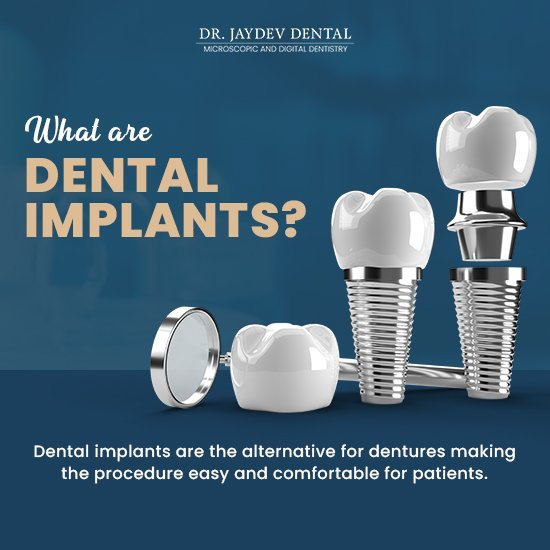
Dental implants are basically a fixed replacement for a missing tooth, and for most patients, they come closer to a real tooth than anything else on the menu. We suggest them when one or more missing teeth need replacing without dragging the neighbouring ones into a bridge. A tiny titanium post goes into the jawbone, we leave it alone for a few months to bond with the bone, and once that’s done, a custom crown placed on top and covered by dental caps finishes the job.
Why are implants everyone’s first pick now? Simple. They stay put, you chew normally, and the jawbone below doesn’t shrink the way it does with dentures or bridges.
What does Dental Implant Surgery Entail?
Dental implant treatment isn’t a one-visit thing, it’s a process, and honestly, patience matters more than people expect. The titanium post needs real time to bond with the jawbone, and when patients rush that step, we see failed dental implant cases down the line. Most of our dentists spread treatment over 3 to 6 months, sometimes longer if a bone graft enters the picture.
Here’s roughly how the whole thing plays out.
- Pulling out damaged or decayed teeth that aren’t worth saving, because leaving them creates bigger issues later.
- Checking jaw health with X-rays or digital scans first, since the implant lives or dies by bone quality.
- Prepping the jawbone for the screw, grafting if the bone is thin or spongy.
- Fitting the abutment and then the final artificial tooth.
- Osseointegration, the quiet part where bone hugs the titanium.
Know the Actual procedure of dental implant.
Ever wondered how an artificial tooth is so strong and natural looking?
To understand this, we need to make it clear what actually happens during dental implants treatment.
Most implant journeys kick off with removing the broken or decayed tooth, cleaning out the socket, and if bone volume is low, we add a bone graft. That graft does the quiet work of encouraging new bone growth so the titanium has something dense to grip.
The surgery itself is less dramatic than people assume. We drill a precise channel into the jawbone, thread the titanium post in at the right angle and depth, and that becomes the post inserted acts as the artificial root. Once healing wraps up, an abutment sits over the post, and a custom crown, shade-matched to the rest of your teeth, gets cemented or screwed on top.
Still unsure if implants are safe for you?
The Advantages of having the Dental Implants
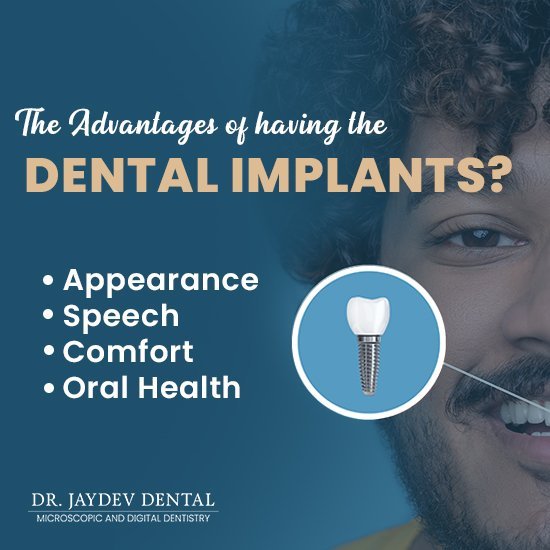
As we discussed above, implants are reliable dental procedures with a 95 % success rate. Some of the noticeable and awaited advantages include:
Appearance: Looks like a tooth you grew, right down to how it comes out of the gum.
Speech: No slipping, no lisp, none of the slurred consonants patients get with loose dentures.
Comfort: Fixed for good, so no rubbing, no taking them out at night, no adhesive routine.
Oral Health: The implant and any bone graft keep the jaw stimulated, which is what stops the bone from thinning.
Also, read our blog, why choose dental implants over dentures?
Understand the Complications Post Treatment
Getting the dental implant treatment is often the fix that stops bigger problems in the jaw and surrounding teeth. What you do after surgery is what decides how long the results actually last. A few things to steer clear of during recovery:
Stop Using Tobacco products: Smoking chokes the blood supply to the gums, and it’s genuinely one of the biggest reasons implants fail to bond.
Never deny brushing and flossing of teeth.
Consult a dentist for regular check-up and observation.
Know Some Unspoken Truths about Dental Implants
- The surgery is way less dramatic than people build it up to be, most patients walk out surprised at how normal it felt under local anaesthesia.
- The “healing time” isn’t really downtime, it’s the titanium fusing into your bone, and that’s what gives the implant its long-haul strength.
- Implants don’t need special toothpaste or fancy routines, just regular brushing, flossing, and not skipping checkups.
- You get two wins at once, a tooth that looks natural, and a jawbone that stays protected for years after.
How Safe are Dental Implants?
Dental implants have a long track record of working, and yes, they’re one of the safest fixes for replacing the missing tooth. But they’re not a universal solution. Patients with untreated gum disease, uncontrolled diabetes, or a serious smoking habit are usually asked to sort those issues out first, because the risk goes up in their case, not because the implant itself is unsafe.
One underrated advantage people forget to mention: implants stop the teeth next to the gap from tilting or drifting, which is the quiet culprit behind bite problems later on.
In Conclusion
To wrap this up without padding it. Titanium implants hold up long-term, complications are uncommon when the procedure is done right. Side effects, when they do show up, are usually minor, manageable, and not something every patient runs into.
If you’re still sitting with the “are implants safe” question in your head, book an appointment at Dr. Jaydev clinic and get proper clarity from the dentist, not from a search result.
Ready for a permanent, worry-free smile?
1. How soon can I have my dental implants after tooth extraction?
The socket usually needs 3 to 6 months to heal before the implant goes in, so the jaw can actually hold the post firm. In select cases with solid bone, same-day implant placement right after extraction is on the table.
2. Are dental implants painful during or after the surgery?
The surgery runs on local anaesthesia, so you won’t feel pain during placement. Some soreness or swelling for 3 to 5 days afterwards is normal, and it settles easily with the medication we prescribe.
3. Can I remove dental implants or do they stay in my mouth?
Implants are meant to stay, just like a real tooth. Once they fuse into the jawbone, they aren’t coming out at home, and that’s exactly what gives them the strength and natural feel people ask for.
4. What can I eat after Dental Implantation?
For the first two, maybe three days, stick to fluids and soft stuff, eggs, milkshakes, cereals, soups, ice creams, soft fruits. After that, slowly bring in soft chewable food, and keep crunchy or sticky items off the plate until chewing feels completely normal.
5. How long do dental implants last?
With decent oral hygiene and regular checkups, implants can easily go a lifetime. The crown on top might need swapping after 10 to 15 years, but the titanium post itself is built to stay.
Refrences
- American Academy of Implant Dentistry (AAID) — What Are Dental Implants? https://www.aaid-implant.org/what-are-dental-implants/
- National Library of Medicine (PubMed) — Long-term success and survival rates of dental implants: A systematic review. https://pubmed.ncbi.nlm.nih.gov/