
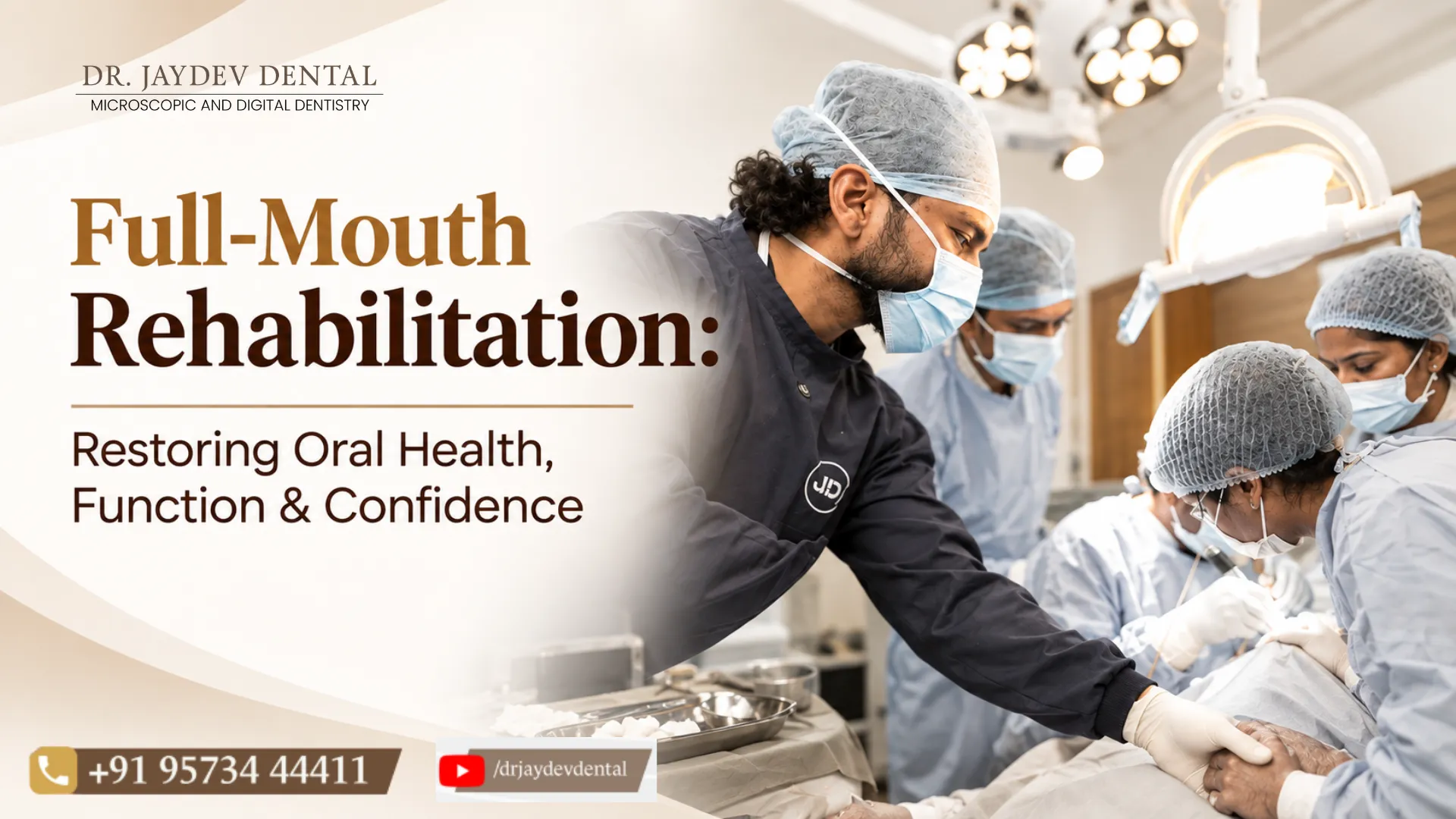
Full-Mouth Rehabilitation: Restoring Oral Health, Function & Confidence
Patient
Senior Patient
Clinical Focus
Failed & Infected Dental Implants, Digital Treatment Planning
Treatment
Full-Mouth Rehabilitation with 3D-Guided Implant Placement
Introduction
Complex dental cases often require more than a single procedure. When previous implant treatment has failed and infection is present, careful diagnosis, precise planning, and a coordinated treatment approach become essential.
At Dr. Jaydev Dental Clinic, this case involved a senior patient who presented with previously failed and infected dental implants and needed restoration of both oral function and aesthetics.
The treatment focused on eliminating the existing infection, carefully evaluating the available bone, and using advanced digital technology to plan and execute a new implant-supported full-mouth rehabilitation.
The Patient's Concern
The patient had undergone previous dental implant treatment that had failed and become infected. He was looking for a reliable solution to restore his oral health, function, and confidence.
He was experiencing:
- Previously failed dental implants
- Infection associated with the earlier treatment
- Compromised oral and bone conditions
- Difficulty with overall oral function
- Loss of confidence due to the condition of his teeth
Given the history of previous treatment failure, the case required detailed assessment and careful planning before any further surgical intervention.
The Challenge
The primary challenge was to create a healthy foundation for new implant placement while addressing the complications associated with the previous treatment.
The treatment needed to:
Address and eliminate residual infection
Carefully assess the available bone and oral structures
Avoid repeating the complications of the previous treatment
Plan implant positions with maximum precision
Restore stable oral function and aesthetics
Because this was a complex revision case, every stage needed to be carefully coordinated before proceeding with surgery.
Why Digital Treatment Planning Was Chosen
To improve precision and reduce uncertainty during implant placement, the clinical team used an advanced digital treatment-planning workflow.
High-resolution oral scans were used to recreate the patient’s oral anatomy and evaluate the relevant bone structures. This digital information was then used to plan the implant positions using 3D computer-aided design.
A customized 3D-printed surgical guide was subsequently created to transfer the planned implant positions accurately to the patient’s mouth.
The guided approach helped the team plan:
- The precise location of each implant
- Implant angulation and depth
- The overall implant placement sequence
- A more controlled surgical workflow
This patient-specific planning was particularly important because of the previous implant failure and the complexity of the case.
The Treatment Process
The treatment was carried out through a carefully coordinated, multi-stage approach.
The process included:
- Detailed clinical evaluation and pre-surgical assessment
- Oral scanning and digital reconstruction of the patient’s anatomy
- 3D computer-aided implant planning
- Fabrication of a customized 3D-printed surgical guide
- Evaluation of blood parameters before surgery
- Management and removal of residual infection
- Guided implant placement using the digitally planned surgical guide
- Comprehensive full-mouth rehabilitation
Throughout the treatment, the clinical team maintained strict sterilization and surgical protocols to create a suitable environment for implant treatment.
Compassionate Care Throughout the Treatment
For patients undergoing complex revision procedures, treatment is not only about the clinical process. Trust, communication, and emotional reassurance can also play an important role.
The team maintained clear communication with the patient throughout the treatment, helping him understand each stage of the process and addressing his concerns along the way.
The patient’s family members, who were abroad and understandably concerned about his treatment, were also kept reassured through clear communication.
The focus was to make the patient feel supported and comfortable throughout what could otherwise have been an overwhelming experience.
The Outcome
The multi-stage full-mouth rehabilitation was completed successfully, with the treatment focused on restoring the patient’s:
- Oral health
- Dental function
- Smile aesthetics
- Confidence in everyday interactions
By combining digital treatment planning, 3D-guided implant placement, careful surgical execution, and personalized patient care, the team was able to approach this complex revision case in a structured and precise manner.
What Makes This Case Special
Complex case involving previously failed and infected dental implants
Detailed digital assessment and treatment planning
3D computer-aided implant positioning
Customized 3D-printed surgical guide
Coordinated multi-disciplinary clinical approach
Careful attention to infection management and surgical protocols
Strong focus on patient and family communication
Full-mouth rehabilitation aimed at restoring function, aesthetics, and confidence
This case demonstrates how advanced digital dentistry, precise treatment planning, clinical teamwork, and compassionate patient care can come together to manage complex implant cases and support a comprehensive full-mouth rehabilitation.
