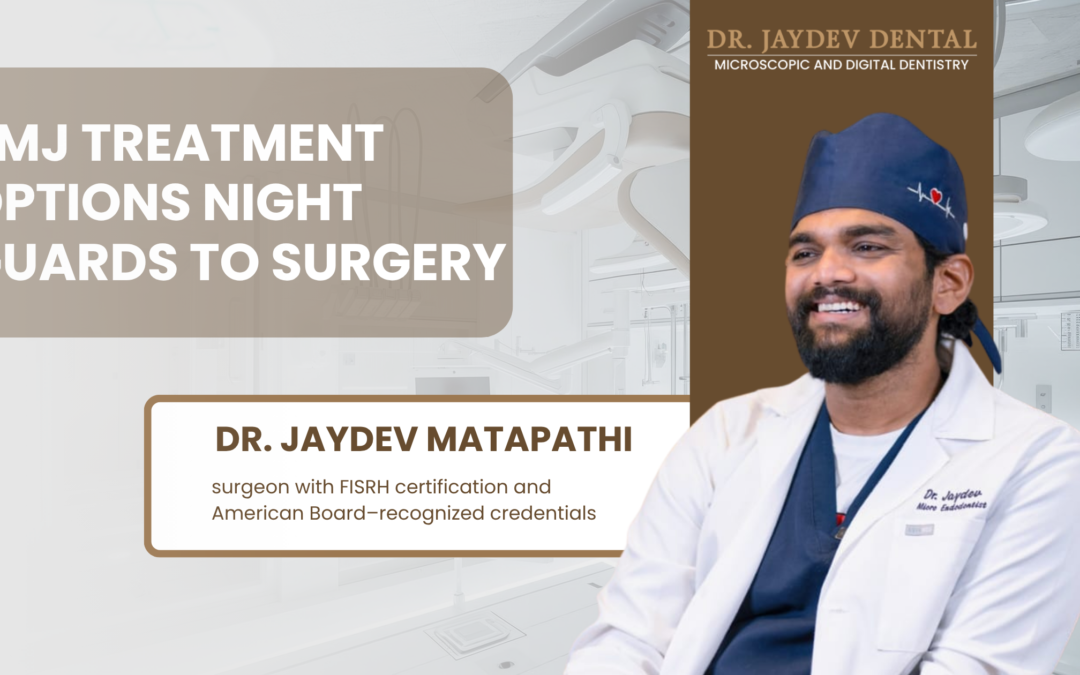
Temporomandibular joint disorders affect roughly 10-15% of adults and most cases respond to conservative treatment without surgery. Night guards handle grinding-related TMJ for ₹2,000-₹8,000. Physical therapy works for muscle tension. Botox (₹5,000-₹15,000) relaxes overactive jaw muscles. Arthrocentesis flushes the joint for ₹10,000-₹25,000. And open surgery (₹50,000-₹2,00,000+) only enters the picture when imaging confirms structural damage that nothing else can fix.
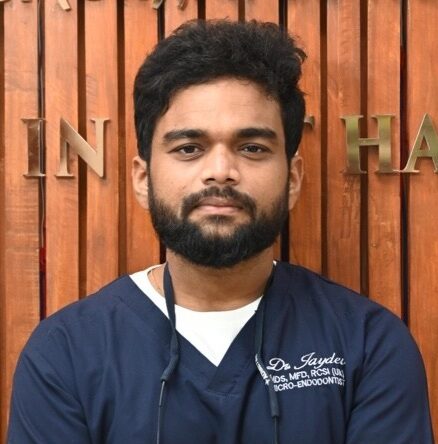
According to Dr. Jaydev Matapathi, smile design specialist in Hyderabad, “Most TMJ patients do not need surgery. They need a proper diagnosis first because muscle tension and disc displacement feel identical but need completely different treatment.”
Get your gum disease assessed and priced clearly today.
What Non-Surgical Options Work for TMJ?
About 80% of cases get better without anyone cutting into the joint. Conservative first is almost always right.
Custom night guard. Stops teeth from grinding together during sleep, takes load off the joint. ₹2,000-₹8,000 depending on the material. This alone fixes a surprising number of TMJ cases.
Jaw exercises and physical therapy. Stretching and strengthening the muscles around the joint. Boring work honestly. But consistent PT over 6-8 weeks reduces clicking and pain in muscle-origin TMJ better than most people expect.
Botox into the masseter. When the jaw muscle clenches involuntarily and the night guard is not enough on its own. Targeted injection relaxes the muscle for 3-4 months. You stop clenching without thinking about it.
NSAIDs and warm compresses during flare-ups. Not a fix. More of a management tool while the actual treatment takes hold. Ibuprofen brings inflammation down and moist heat loosens tight muscles on bad days.
For TMJ caused by a bad bite, orthodontic treatment fixes the underlying cause. And when grinding already wore teeth down, crowns and bridges rebuild what the clenching destroyed.
When Does TMJ Actually Need Surgery
Surgery shows up only after conservative treatment has failed for 3-6 months and scans confirm something structural is wrong inside the joint.
Arthrocentesis when the disc is stuck. Needle goes in, flushes fluid through the joint space, washes out inflammatory junk, frees the disc. Done under local anaesthesia. ₹10,000-₹25,000. Minimally invasive and recovery is quick.
Arthroscopy for internal damage. Tiny camera through a small incision. Scar tissue cut away, disc repositioned, rough surfaces smoothed out. A week or two of recovery. Not as scary as it sounds but it is still surgery.
Open joint surgery when nothing else reaches the problem. Larger incision, direct access to the joint for disc repair or removal. ₹50,000-₹2,00,000+. Recovery takes longer. But for joints with degeneration that arthroscopy cannot address, this is what is left.
Full joint replacement in end-stage cases. Prosthetic joint replaces a condyle destroyed by arthritis or trauma. Rare and always a last resort after everything else has been tried and failed.
For joint imaging, CBCT scanning shows anatomy regular X-rays miss. And when tooth loss changed the bite enough to trigger TMJ, dental implants restore proper occlusion.
Why Choose Dr. Jaydev Dental Clinic?
Dr. Jaydev Matapathi (MDS, MFD RCSI, MFDS RCPS UK) diagnoses TMJ with clinical examination, bite analysis, and CBCT when the joint itself needs assessment. Over 336 Google reviews at 4.9 rating. Conservative management first, surgical referral only when imaging confirms structural damage that splints and therapy cannot fix.
Patients living with jaw clicking and pain for years without answers usually find that proper imaging finally explains what is going on. And that changes the treatment conversation entirely.
📞 Call Now: 09573444411
Reference links
- ndian Dental Association — https://www.ida.org.in/
- American Dental Association — https://www.ada.org/
Frequently Asked Questions
Do most TMJ cases need surgery?
No, roughly 80% improve with night guards, exercises, and conservative care alone.
How much does a TMJ night guard cost?
₹2,000-₹8,000 for a custom-fitted splint from your dentist.
Can Botox help with TMJ pain?
Yes, relaxes overactive jaw muscles for 3-4 months per session.
How do I know if my TMJ is serious?
Jaw locking, worsening pain over months despite conservative care, and inability to open fully suggest structural damage needing imaging.