
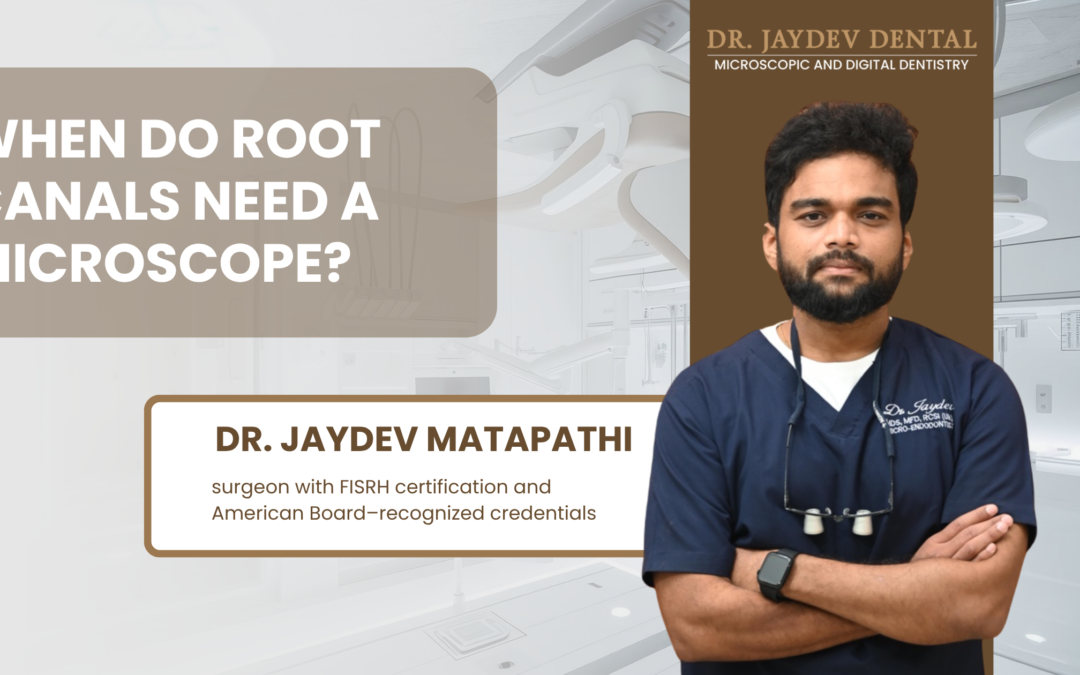
Not every root canal needs a dental microscope. A straightforward single-canal front tooth with a clear X-ray and no complications does fine without one. But the moment the case gets tricky, missed canals, failed previous treatment, calcified roots, suspected cracks, the microscope becomes the difference between saving the tooth and losing it. About 30% of root canal failures happen because a canal was missed during the first treatment. A microscope at 20-25x magnification finds what the naked eye and loupes cannot.
According to Dr. Jaydev Matapathi, smile design specialist in Hyderabad, “I have found fourth and fifth canals under the microscope that three previous dentists missed with loupes. The tooth was scheduled for extraction. It is still in the patient’s mouth two years later.”
Get your gum disease assessed and priced clearly today.
Which Cases Actually Need Microscope Magnification?
Simple root canals do not. But these specific situations change the outcome entirely when a microscope is used.
- Molars with hidden extra canals. Upper first molars frequently have a fourth canal called MB2 that is missed in over 40% of cases done without magnification. That one missed canal is enough to keep the infection alive.
- Retreatment of a previously failed root canal. Old filling material needs complete removal. Ledges and blockages created by the first dentist need navigating around. Missed canals from the original treatment need locating. All of this is guesswork without magnification.
- Calcified or narrow canals in older patients. Years of calcium deposits shrink the canal opening to a pinhole. Finding that opening without a microscope means drilling blindly and risking perforation through the side of the root.
- Suspected vertical root fracture. A hairline crack running down the root is invisible at normal magnification and on X-rays. The microscope confirms it before the dentist spends an hour treating a tooth that was never going to survive.
For the standard procedure, read about root canal treatment. And for cases beyond saving, dental implants replace what microscopic treatment cannot rescue.
When Is a Microscope Not Necessary?
Using a microscope on every case is like using a CT scan for a paper cut. Some root canals are simple enough that standard visibility works fine.
- Single-canal front teeth with clear anatomy. One straight canal, visible on X-ray, no previous treatment, no calcification. An experienced endodontist handles this accurately with loupes alone.
- Premolars with uncomplicated two-canal anatomy. When both canals are clearly visible and the tooth has never been treated before, standard magnification is sufficient for thorough cleaning and shaping.
- Young patients with wide open canals. Teeth in patients under 25 often have large pulp chambers and wide canals that are easy to locate, clean, and fill without microscopic assistance.
- Emergency pulpotomy or partial treatment. When the goal is pain relief and temporary treatment before definitive root canal later, microscope setup adds time without changing the immediate outcome.
For complex cases needing the microscope, microscopic root canal treatment explains the process. And for teeth needing protection after treatment, crowns and bridges prevent fracture of root-canal-treated teeth.
Why Choose Dr. Jaydev Dental Clinic?
Dr. Jaydev Matapathi (MDS, MFD RCSI, MFDS RCPS UK) uses a dental operating microscope as standard for all molar root canals and every retreatment case. Over 336 Google reviews at 4.9 rating, with teeth saved under microscope that were scheduled for extraction elsewhere because the missed canal was finally found and treated.
The microscope is not an upsell here. For simple front teeth it is not used. For molars, retreatments, and anything complicated it is non-negotiable. That distinction gets made during assessment based on what the tooth actually needs.
📞 Call Now: 09573444411
Reference links
- Indian Dental Association — https://www.ida.org.in/
- American Academy of Implant Dentistry — https://www.aaid.com/
Frequently Asked Questions
Does every root canal need a microscope?
No, simple single-canal front teeth do fine without one.
What is the most common reason for needing a microscope?
Missed canals, especially the MB2 canal in upper molars missed in 40%+ of non-microscope cases.
Does microscope root canal cost more?
Slightly, but the higher first-time success rate avoids retreatment costs that far exceed the difference.
Can a microscope save a tooth scheduled for extraction?
Often yes, when the reason for extraction was a missed canal or undiagnosed crack that magnification reveals.