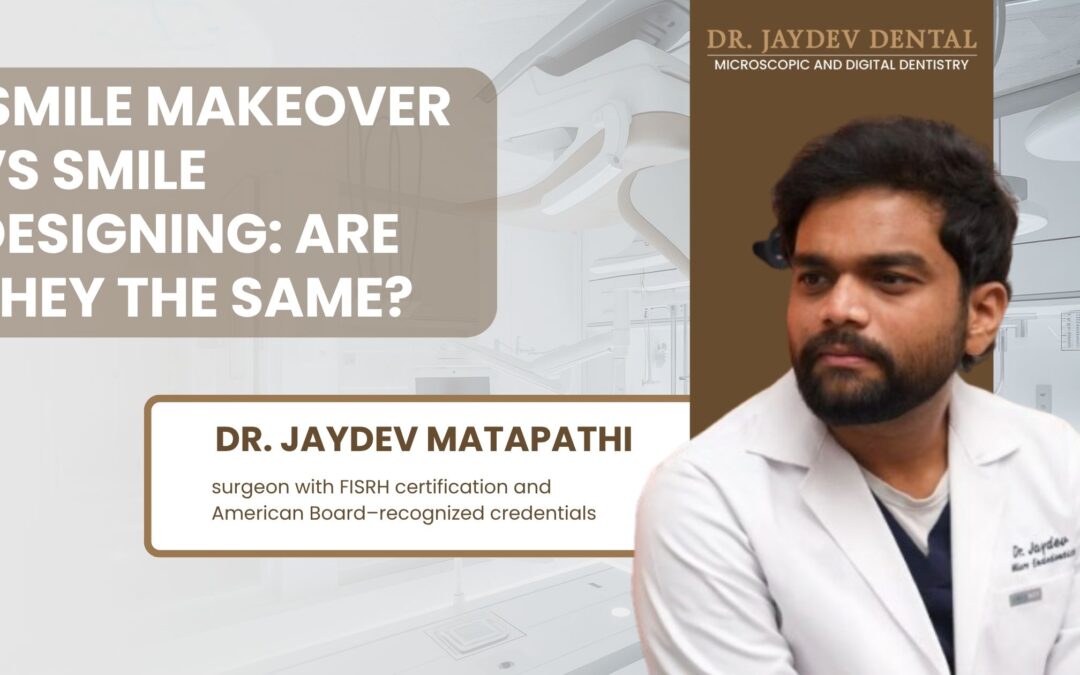
Smile makeover and smile designing are closely related but not the same thing, and they’re often used together to create one final result. Smile designing is the digital and artistic planning phase, basically the blueprint of your future smile. A smile makeover is the actual execution, the clinical building process where treatments like veneers, whitening, or crowns deliver that planned outcome. One designs. The other builds.
According to Dr. Jaydev Matapathi, smile makeover in Hyderabad, Most patients walk in asking for a makeover without realising the design phase is what decides whether the result looks engineered or natural, skip it and you’re letting the dentist guess your face proportions.
Not sure which stage your case actually starts from?
What is the actual difference between smile makeover and smile designing?
Both terms describe parts of the same outcome but they work at different stages of the process.
- Nature: Smile designing is a planning and visualisation exercise done on screen and on models, while a makeover is the hands-on clinical treatment that physically changes teeth.
- Tools used: Designing uses Digital Smile Design software, intraoral scans, photographs, and wax mock-ups, whereas a makeover uses veneers, crowns, whitening, gum contouring, or aligners depending on what’s needed.
- Outcome at end: A design session ends with a digital or physical preview of the new smile, but a makeover ends with the actual transformed smile in your mouth.
- Reversibility: Designing is fully reversible since nothing gets touched, but most makeover procedures involve some permanent enamel reduction or bonding work.
Designing answers “what should this look like.” Makeover answers “let’s make it look that way.” Veneers in Hyderabad are usually where the design becomes visible.
Do you need both stages, or is one enough?
Depends on what’s being changed and whether function is part of the picture.
- Just whitening: If teeth are healthy and aligned and only shade is an issue, a clinical assessment is enough, no full design protocol needed.
- Front teeth aesthetics: For chips, gaps, or shape correction in the smile zone, a quick design preview before placing dental veneers prevents proportion mistakes that look obvious in selfies later.
- Bite or function involved: When worn edges, jaw discomfort, or missing teeth are part of it, designing alone won’t fix anything, the makeover has to include restorative work.
- Multi-arch or full-face cases: Both stages are non-negotiable here, because executing a full transformation without a digital blueprint usually leads to mismatched midlines or off-looking lip support.
Honest answer? Most well-done cases use both. Design protects the makeover from looking generic.
For collapsed or severely worn bites, full mouth rehabilitation in Hyderabad overlaps both stages and goes further.
Want a deeper breakdown of when designing alone isn’t enough? Read Smile Designing vs Full Mouth Rehabilitation: Which One Do You Need?
Why do patients choose Dr. Jaydev Dental?
Dr. Jaydev Matapathi is a UK-trained dental specialist with dual specialisation in Microscopic Endodontics and Smile Designing, holding MDS, MFD (RCSI, UK) and MFDS (RCPS, UK), and is a three-time IACDE Clinical Excellence Award winner with over a decade of experience in cosmetic and reconstructive dentistry.
Every smile case at the clinic begins with a documented digital design phase before any clinical treatment starts. That’s why patients leaving Jubilee Hills with veneers or full transformations rarely come back complaining about uneven gum lines or unnatural shade matches. No shortcuts. No guesswork.
Frequently Asked Questions
Is smile designing always part of a smile makeover?
Ideally yes, but smaller cases can skip it if only one tooth needs work.
Can I see my new smile before treatment starts?
Yes, smile designing gives you a digital and physical preview before any procedure.
How long does the design phase take?
Usually one to two visits, depending on case complexity and chosen treatment plan.
Is the makeover process painful?
No, most procedures are done under local anaesthesia with minimal post-treatment discomfort.