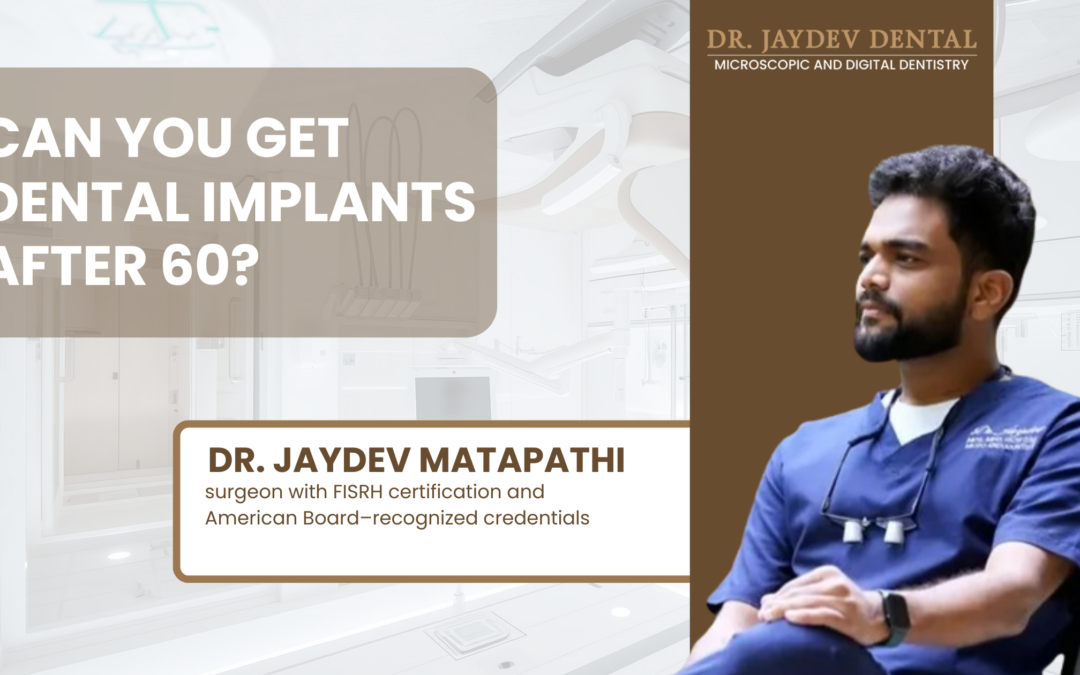
Yes, you can get dental implants after 60. Age alone isn’t a barrier, since overall health and bone quality matter far more than the number itself. Studies show survival rates above 95% in patients over 65, comparable to younger adults. What actually decides the outcome is bone density, gum health, and any managed conditions like diabetes. So sixty isn’t a cutoff. It’s just a number on the chart.
According to Dr. Jaydev, an expert in best dental implants, I’ve placed implants in patients well into their seventies who heal better than someone half their age, because what counts is the bone and the health, not the birthday.
Wondering if your health supports implants?
Does Age Affect Dental Implant Success?
Age on its own carries little weight. What sits underneath it matters far more.
Bone Quality: The jawbone has to hold the post, so density and volume count for more than how many years a patient has behind them.
General Health: Well-managed conditions rarely rule anyone out, though uncontrolled ones like diabetes need sorting before surgery.
Healing Capacity: Older patients can heal a touch slower, but with good circulation and nutrition the difference is often smaller than expected.
Gum Health: Then there’s the gum tissue. Healthy gums give an implant the foundation it needs, regardless of the patient’s age.
So the assessment looks at the body, not the calendar. For patients missing several teeth, full mouth dental implants remain a strong option well past sixty.
What Should Older Patients Consider Before Implants?
A few checks before surgery help older patients head into the procedure with confidence.
Bone Scan: A 3D scan shows whether the jaw has enough bone, or whether grafting comes first to build a stable base.
Medication Review: Some drugs, blood thinners and bone medication especially, affect healing and need flagging well before the procedure.
Health Check: Looping in the patient’s physician keeps any chronic conditions managed alongside the dental work rather than against it.
Realistic Timeline: And healing may run a little longer, so planning the timeline around that keeps expectations grounded from the start.
Done with proper planning, an implant at sixty-five can serve just as well as one at forty. Patients restoring multiple teeth sometimes look at full mouth rehabilitation as part of the wider plan.
For more on how long dental work holds up over time, see our guide on how long porcelain veneers last.
Why Choose Dr. Jaydev Dental ?
Dr. Jaydev holds MDS, MFD RCSI (UK), and MFDS RCPS (UK) qualifications, with UK training and dual specialisation in microscopic endodontics and smile designing. Older patients are assessed on their full health picture, not waved off because of a birth year.
Plenty of patients arrive assuming they’re too old, only to find out they’re solid candidates. He checks the bone, reviews the medication, coordinates with their doctor, and plans around how they actually heal.
Frequently Asked Questions
Is there an age limit for dental implants?
No, there’s no upper age limit when overall health and bone quality support the procedure.
Do older adults heal slower after implants?
Sometimes slightly, though good health and nutrition keep the difference minimal.
Can someone with dentures switch to implants after 60?
Yes, many older patients move from loose dentures to implant-supported teeth successfully.
Does bone loss with age affect implants?
It can, which is why a bone scan and possible grafting are assessed first.