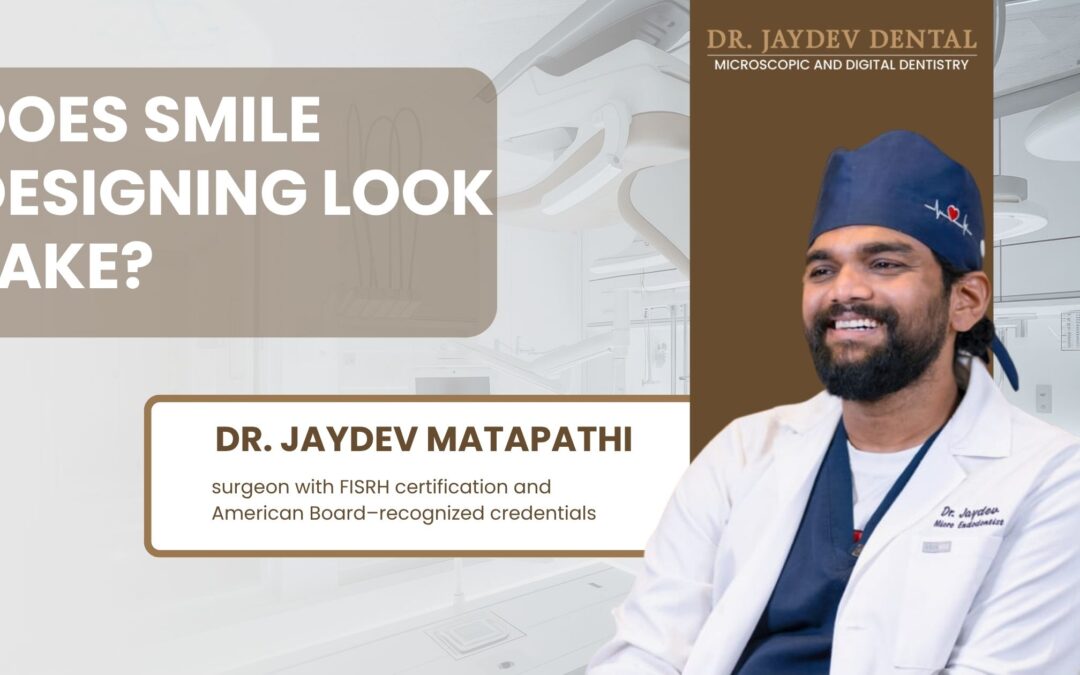
Smile designing only looks fake when it’s poorly planned, using overly white, opaque, or improperly sized teeth that don’t match the patient’s facial structure. When executed by an experienced cosmetic dentist, smile design creates a natural, customized, and balanced look that harmonizes with your face.
According to Dr. Jaydev, an experienced smile design specialist in Hyderabad, Most patients who come in worried about looking fake have seen badly planned cases, not bad dentistry — the difference is always in the planning stage.
Concerned your smile makeover might not look like you?
Why Does Poorly Planned Smile Designing Look Fake?
Bad outcomes almost always come down to a handful of clinical decisions that happen long before any veneer is placed.
- Shade too white: Teeth brighter than the whites of your eyes don’t read as real under any lighting condition, and this single error is responsible for most cases that look obviously cosmetic rather than natural.
- Wrong tooth size: Veneers that are too wide, too long, or uniformly square ignore the natural variation between central incisors, laterals, and canines, and that uniformity is exactly what the eye picks up as artificial.
- No gum contouring: When gum levels aren’t balanced before restorations go in, even a well-made veneer sits crooked in the frame, and nothing throws off a smile’s naturalness faster than an uneven gumline.
- Skipping facial analysis: Lip movement, the amount of tooth visible during a real smile versus a posed one, and the width-to-height ratio of the face all feed into what size and shape works, and skipping this analysis is what produces results that look fine in a photo but wrong in person.
A proper smile makeover always starts with facial mapping, not impressions.
How Do You Get Smile Designing Results That Actually Look Real?
Natural-looking outcomes aren’t luck. They come from a planning process that treats every patient’s face as different, because it is.
- Translucent porcelain: Natural enamel has depth, colour gradients, and incisal translucency, and layered porcelain that mimics these characteristics visually blends into the existing smile instead of sitting on top of it like a cap.
- Mock-up review: A wax or digital preview worn or seen before any tooth prep lets you flag proportion issues early, and most patients change something at this stage that they wouldn’t have caught from a screen rendering alone.
- Proportion science: The width of your central incisors should mirror the width of your philtrum and align loosely with your nose base, so the planning starts with measurements, not a shade guide.
- Material matching: Feldspathic porcelain, composite, and zirconia all reflect light differently, and choosing a material that mimics how your surrounding natural teeth behave under indoor versus outdoor lighting is what separates results that look real from results that look expensive.
So the question isn’t really whether smile designing can look natural. It almost always can, if it’s planned properly. Our blog on dental veneers goes into what that preparation process looks like in detail.
Why do patients choose Dr. Jaydev Dental?
Dr. Jaydev is a UK-trained endodontist and smile design specialist with over a decade of experience in cosmetic and restorative dentistry, trained in digital smile design with an in-house workflow that covers facial analysis, mock-up creation, and final placement without outsourcing any stage.
What patients consistently mention is the mock-up appointment. Most say it’s the first time they’ve ever seen what their actual result would look like before agreeing to anything, and several have changed their shade or tooth length at that stage because seeing it in person is completely different from looking at a screen simulation.
Reference links
- Dental Aesthetics and Smile Planning — Journal of Prosthetic Dentistry, NIH
- Shade Selection in Cosmetic Dentistry — PubMed, NCBI
Frequently Asked Questions
Does smile designing always require veneers?
No. Bonding, whitening, or contouring alone can achieve natural results in many cases.
How long does smile design planning take before treatment starts?
One to two consultation sessions, including facial analysis and mock-up review, before any preparation.
Is smile designing permanent?
Porcelain veneers are a long-term commitment; composite bonding can be adjusted or removed if needed.
How do I preview my smile design result before treatment?
A wax mock-up or digital simulation is approved by you before any clinical preparation begins.