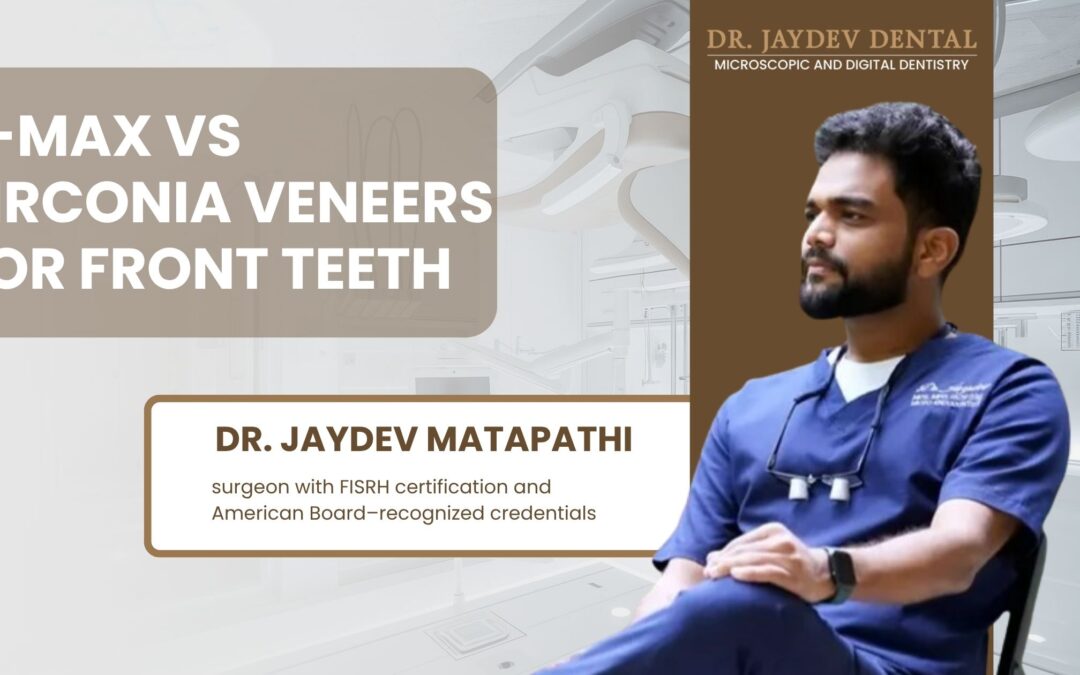
For front teeth, E-Max veneers are generally better than zirconia due to superior aesthetics, translucency, and a natural enamel-like appearance. E-Max, made from lithium disilicate, is the industry standard for cosmetic high-visibility areas. Zirconia veneers offer greater strength, making them better suited for back teeth or patients with bruxism.
According to Dr. Jaydev, Veneers in Hyderabad, Front teeth need light passing through them the way enamel does, and that’s something E-Max just handles better than zirconia in nearly every smile design case I’ve worked on.
Worried your veneers might look opaque or fake up close?
What makes E-Max veneers better suited for front teeth?
Lithium disilicate is the reason. It’s a glass-ceramic and behaves optically a lot closer to real enamel than zirconia ever will.
- Translucency: Light actually passes through E-Max, almost like it does through your real enamel, and that gives the veneer a depth zirconia can’t really fake, especially when you’re standing near a window or in daylight.
- Thinness: We’re talking 0.3mm in some cases. So very little enamel comes off the tooth, and the structure underneath stays mostly the way nature built it.
- Bonding: E-Max chemically bonds to the tooth with adhesive resin. That’s not a small thing, because the bond actually reinforces the prep, and debonding becomes pretty rare over the years.
- Color match: Shade blending is honestly easier with E-Max because the material picks up surrounding light, so the veneer doesn’t sit there looking flat against the rest of your smile like a tile pasted on a wall.
If you’re planning a front teeth makeover, a proper smile design consultation is really the only way to know if E-Max suits your case.
When does zirconia make more sense than E-Max?
Zirconia isn’t wrong for front teeth. It just shines in different situations, mostly the ones where strength matters more than how the veneer catches the light.
- Heavy bite: Grinders. Deep-bite patients. Anyone whose jaw clenches at night without realising. Thinner ceramics tend to crack under that kind of load, and zirconia just doesn’t, even years in.
- Discoloured tooth: If the tooth underneath is dark, or root-canal treated, or stained from old tetracycline use, zirconia’s opacity actually does you a favour and masks it. E-Max would let that darkness bleed through.
- Bridge work: For multi-unit bridges across the front teeth, zirconia gives you the structural backbone, and modern layered zirconia has come a long way in the looks department.
- Cost factor: Monolithic zirconia is usually a bit easier on the wallet per unit, lasts long, and that adds up when you’re doing six or eight teeth in one go.
For a deeper read on full-mouth aesthetic planning, our piece on smile makeover options in Hyderabad covers the material call in more detail.
Why do patients choose Dr. Jaydev Dental?
Dr. Jaydev brings over 15 years of work in cosmetic and restorative dentistry, with hundreds of smile design cases done across E-Max, zirconia, and composite veneer systems. His prep is conservative, which matters more than people think. Once enamel’s gone, it’s gone.
What patients keep mentioning is the chair time that goes into shade picking and the trial smile stage before any tooth gets touched. Nothing rushed. You see what it’s going to look like before it’s actually permanent.
Frequently Asked Questions
Are E-Max veneers stronger than natural teeth?
E-Max sits around 400 MPa flexural strength, a touch stronger than natural enamel.
Can I see my new smile before treatment starts?
Yes, smile designing gives you a digital and physical preview before any procedure.
How long do E-Max veneers last on average?
With decent care, E-Max veneers run 10 to 15 years comfortably.
Do veneers damage the tooth underneath?
Minimal enamel comes off, and properly bonded veneers actually protect rather than weaken the tooth.