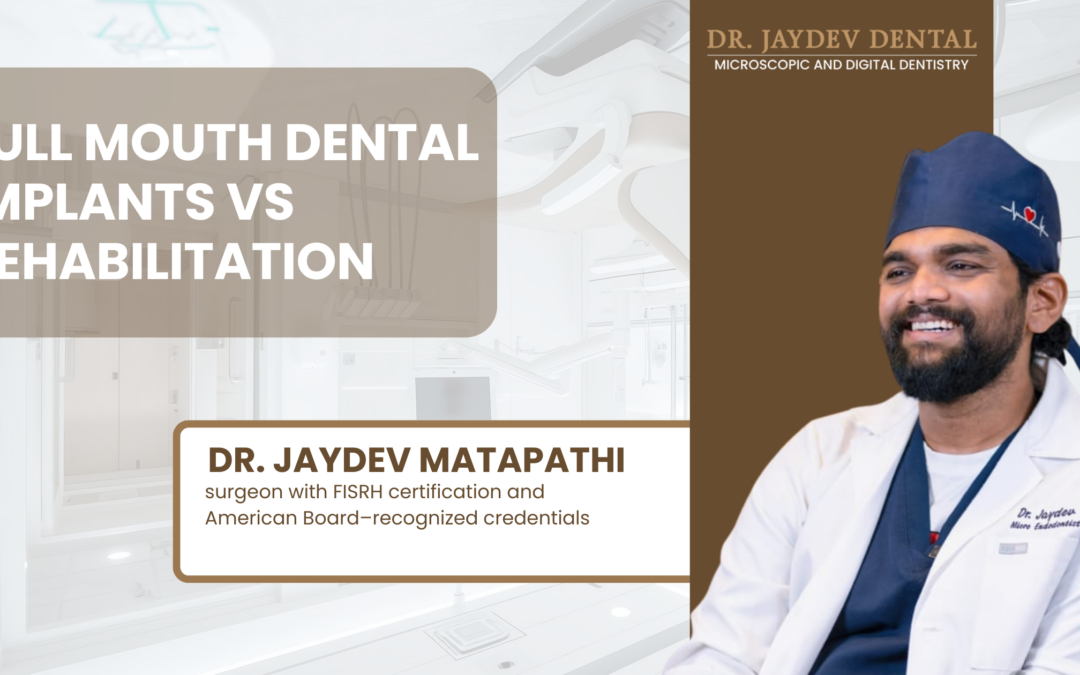
Full mouth dental implants are a specific surgical procedure that replaces missing teeth with artificial titanium roots anchored into the jawbone. Full mouth rehabilitation is the broader treatment plan that restores the health, function, and appearance of all the teeth and gums, and it can include implants but doesn’t always. So one is a single procedure, the other is the whole plan it might fit inside. That’s the part most people get backwards. Implants treat absence. Rehabilitation treats the entire mouth as one connected system, whether that means crowns, bridges, root canals, implants, or some combination shaped around what’s actually there.
Dr. Jaydev, an expert in full mouth dental implants, explains: ‘Implants become the answer when there’s nothing left worth saving, and rehabilitation is what we choose when the natural teeth still have structural value.
Not sure which one your case actually needs?
How Do Full Mouth Implants and Rehabilitation Compare Directly?
The clearest way to separate the two is to line up what each one treats, how it works, and who it suits.
| Factor | Full Mouth Dental Implants | Full Mouth Rehabilitation |
| What it treats | Missing or fully lost teeth | Damaged, worn, or decayed teeth still present |
| Scope | Single surgical procedure | Broad plan that may combine several treatments |
| Natural teeth | Replaced entirely | Saved and rebuilt wherever possible |
| Method | Titanium roots fixed into the jawbone | Crowns, bridges, root canals, sometimes implants |
| Best for | Total tooth loss | Salvageable teeth needing restoration |
| Longevity | Often lasts decades | Depends on condition of restored teeth |
So the split comes down to whether teeth are gone or just struggling. For patients missing teeth across a full arch, All-on-4 dental implants offer a fixed, stable option.
How Does Full Mouth Rehabilitation Differ in Approach?
While full mouth dental implants replace missing teeth entirely with titanium roots, full mouth rehabilitation takes a fundamentally different approach it focuses on preserving and restoring natural teeth that are damaged but remain structurally viable.
Preservation of Natural Teeth: Implants require the extraction of remaining teeth prior to placement. Rehabilitation, by contrast, prioritizes retention. Existing teeth are restored through crowns, root canal therapy, or veneers wherever possible, rather than removed.
Bite Correction: Worn or damaged teeth often compromise occlusion. Where implants establish a new bite through a complete prosthetic arch, rehabilitation realigns the relationship between the upper and lower jaws using the patient’s existing dentition, ensuring that occlusal forces are distributed evenly.
Combination of Procedures: Implants offer a single, unified restorative solution. Rehabilitation typically integrates multiple treatments within one comprehensive plan crowns, bridges, root canal therapy, and other restorative procedures working in coordination.
Aesthetic Integration: Implants deliver a uniform restoration across the arch. Rehabilitation, however, blends new restorations with the patient’s remaining natural teeth, which is essential when preserving original dentition alongside restored elements.
Rehabilitation is the appropriate choice when teeth are salvageable and sufficient structure remains to support restorative work. Patients with widespread wear or decay often benefit from full mouth rehabilitation before extraction is considered. Implants, in contrast, become the preferred option when little viable tooth structure remains.
For more on protecting restored teeth long term, see our guide on maintaining smile designing results.
Why Choose Dr. Jaydev Dental ?
Dr. Jaydev holds MDS, MFD RCSI (UK), and MFDS RCPS (UK) qualifications, with UK training and dual specialisation in microscopic endodontics and smile designing. His work centres on knowing when a tooth can be saved and when full extraction is the honest call.
Patients who arrive expecting full extraction often leave with more of their natural teeth intact than they thought possible. He won’t pull what can be saved, and he won’t rebuild what’s already failing. That’s the line he holds.
Frequently Asked Questions
Can both treatments be combined in one plan?
Yes, many cases use implants for missing teeth and rehabilitation for the remaining natural ones.
Which treatment lasts longer?
Implants typically last decades, while rehabilitation depends on the condition of the restored natural teeth.
Is full mouth rehabilitation painful?
No, procedures are done under anaesthesia with minimal discomfort during recovery.
Do dental implants require surgery?
Yes, implants are surgically placed into the jawbone over planned stages.