A drill spins at high speed and grinds decay out mechanically. A laser vaporises it using focused light energy. No spinning, no vibration, and in many cases no injection. Both get rid of the decay and prepare the tooth for a filling, but how they do it is completely different. The laser is more precise, more comfortable for most patients, and leaves more healthy tooth structure intact. The drill handles larger, deeper cavities better. So which one fits depends on the size and depth of what needs to go.
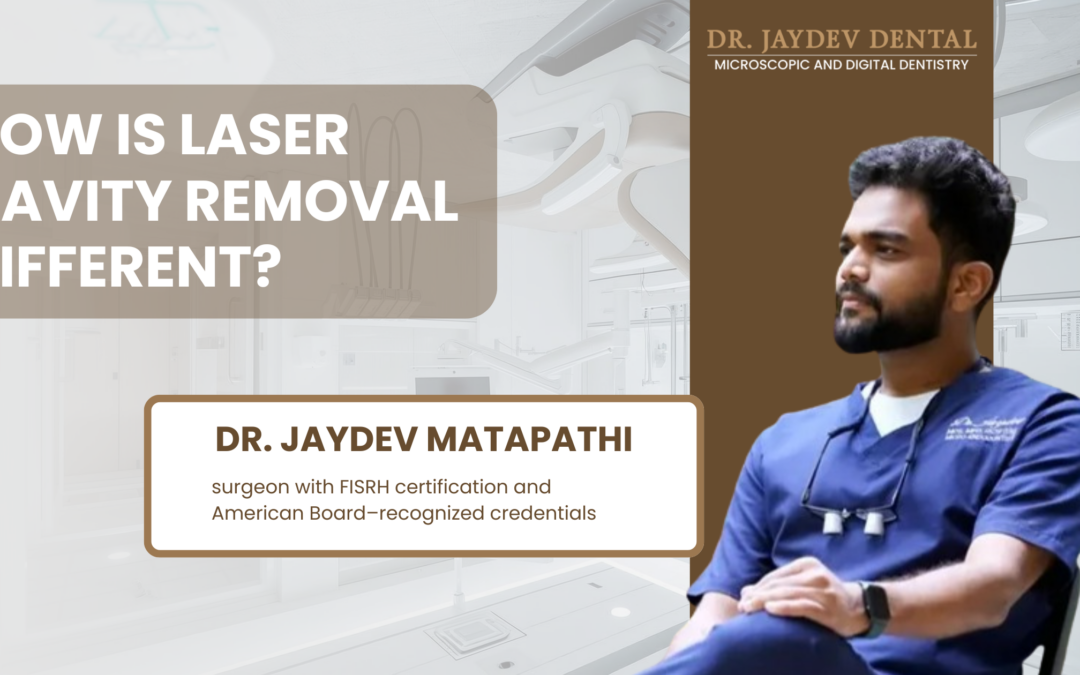
According to Dr. Jaydev, a highly experienced dentist at the laser dental clinic in Hyderabad, “a laser targets only decayed tissue and leaves healthy enamel untouched, which is something a rotary drill can’t match when the cavity is small and accessible.”
Anxious about the drill and considering laser cavity treatment?
What Makes Laser Cavity Removal Technically Different?
Completely different mechanism. One removes tissue by physical force, the other by photochemical vaporisation.
- How it works: A hard tissue laser excites water molecules inside the decayed tissue, vaporising it layer by layer. A drill rotates at several thousand RPM and grinds the decay out with abrasive friction. Same end result, completely different physics.
- Vibration and noise: No rotating instrument means no vibration and no high-pitched drill sound. For anxious patients, that alone changes the experience more than any sedation.
- Anaesthesia need: Because there’s no physical pressure or heat transfer to the nerve, most small laser cavity procedures go ahead without an injection. Drilling almost always needs one.
- Precision: Laser energy distinguishes decayed from healthy tissue far better than a drill bur does. The drill removes a physical margin to make room for the instrument. The laser doesn’t need one.
Factor | Laser | Drilling |
Mechanism | Light vaporisation | Mechanical rotation |
Vibration | None | Significant |
Anaesthesia | Often not needed | Usually required |
Healthy tissue removed | Minimal | More |
Best for | Small to moderate cavities | All sizes including large |
This precision is what sets laser dental treatment apart across every procedure it is used for, not just cavity removal.
When Is Laser Cavity Removal the Better Choice?
Not every cavity qualifies. Three things decide it: size, depth, and the patient.
- Small to moderate cavities: Early and moderate decay where the beam can reach the full cavity without obstruction. Large cavities or decay near the pulp often still need the drill for complete removal.
- Anxious patients: The patient who avoids dental visits because of the drill noise or the needle. Laser removes both. Those patients come in earlier, which means smaller cavities and simpler treatment across the board.
- Children and needle-averse adults: Removing the need for an injection makes a real difference for paediatric cases. Kids who’d need sedation for a standard filling often sit through a laser procedure without it.
- Early intervention cases: Catch decay early enough and a laser handles it cleanly. Let it grow and it becomes a drilling job, then a root canal, then an extraction. The window matters.
Understanding what dental lasers treat beyond cavities is covered in this guide on types of dental lasers and their clinical applications.
Why Choose Dr. Jaydev Dental ?
Dr. Jaydev holds an MDS in Conservative Dentistry and Endodontics with dual qualifications from the Royal College of Surgeons Ireland and the Royal College of Physicians and Surgeons Glasgow. He’s a three-time IACDE Clinical Excellence Award recipient with dual super-specialisation in Microscopic Endodontics and Smile Designing.
Lasers at the clinic aren’t an upgrade option. They’re standard for the cases they suit. Patients who’ve avoided treatment for years because of the drill tend to get through procedures here without the same hesitation.
Frequently Asked Questions
Does laser cavity removal hurt?
Most patients report little to no discomfort, and many procedures need no local anaesthesia.
Is laser cavity removal suitable for all cavities?
No. Laser works best for small to moderate cavities; large or deep decay may still need drilling.
Does laser cavity removal take longer than drilling?
Treatment time is similar to conventional drilling, but without the need for an injection and with a faster recovery afterwards.
Is laser cavity removal safe for children?
Yes, it is particularly suitable for children as it often removes the need for an injection.