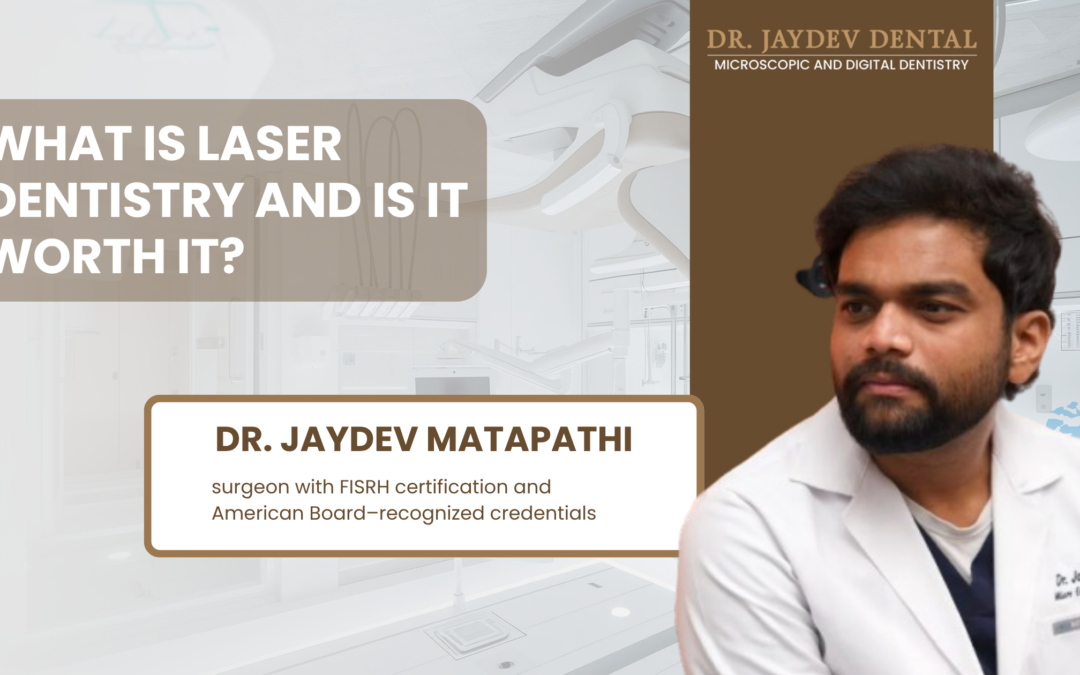
Laser dentistry uses concentrated light energy to cut, ablate, or reshape oral tissue with precision that conventional instruments cannot replicate. Different lasers target different tissues diode and Nd:YAG for soft tissue, Er:YAG and Er,Cr:YSGG for hard and soft tissue, CO2 for surface lesions and gum contouring. The laser coagulates tissue on contact, reducing bleeding and sterilising the site simultaneously. Whether it’s worth it depends on the procedure being done and whether the clinic’s laser type matches the clinical indication.
According to Dr. Jaydev, a leading dental clinic in Hyderabad, “laser dentistry isn’t a single technology it’s a category, and a clinic using a diode laser for cavity preparation is using the wrong tool, which is why the procedure and the wavelength have to match before the word laser means anything clinically useful.”
Considering a laser-based dental procedure and want to know if it suits your specific case?
What Procedures Does Laser Dentistry Cover?
Lasers aren’t a replacement for all conventional dentistry but they do outperform traditional instruments in specific, well-defined clinical situations.
- Gum Disease Treatment: Laser bacterial decontamination inside periodontal pockets removes infected tissue and kills bacteria at wavelengths that penetrate biofilm conventional scaling leaves behind, reducing pocket depth more effectively in moderate to severe periodontitis cases
- Gum Contouring: Excess or uneven gum tissue is reshaped precisely with a soft tissue laser, producing clean margins with immediate coagulation that scalpel-based gingivectomy can’t match for bleeding control and post-operative comfort
- Cavity Preparation: Hard tissue lasers remove decayed enamel and dentine without the vibration of a drill, which is particularly useful for anxious patients and for accessing small interproximal lesions without over-preparation of surrounding healthy tooth structure
- Soft Tissue Lesions: Aphthous ulcers, fibromas, and early-stage mucosal lesions are biopsied or ablated with CO2 or diode lasers in a single appointment with minimal post-operative discomfort and no sutures required in most cases
Laser applications in dentistry keep expanding, and patients exploring options for gum-related concerns specifically will find a detailed breakdown of what’s clinically available at the laser dentistry clinic in Hyderabad.
Is Laser Dentistry Actually Worth the Extra Cost?
The value of laser treatment isn’t universal it’s procedure-specific, and the clinical benefits have to justify the premium in each individual case.
- Reduced Bleeding: Soft tissue lasers coagulate as they cut, which means procedures like frenectomy, crown lengthening, and gum depigmentation involve significantly less intraoperative bleeding and faster post-operative recovery than conventional surgery
- Less Anaesthesia: Several soft tissue laser procedures on healthy gingiva are completed without local anaesthesia because laser energy causes less mechanical trauma than cutting instruments, reducing appointment anxiety particularly for needle-phobic patients
- Faster Healing: The sterilising thermal effect of laser tissue interaction reduces post-operative infection risk and accelerates tissue repair, with most soft tissue laser sites healing visibly within three to five days compared to seven to ten for scalpel wounds
- Precision on Hard Tissue: Hard tissue lasers remove decay selectively without vibration or heat transfer to surrounding tooth structure, preserving more healthy dentine than rotary instruments in cases where the decay margin is close to the pulp
Patients who’ve read about what causes dental plaque already understand how bacterial biofilm drives the conditions laser dentistry treats most effectively, and connecting those two pieces is what makes the treatment decision clearer.
Why Choose Dr. Jaydev Dental ?
Dr. Jaydev is a specialist at the smile makeover in Hyderabad centre with advanced training in laser-assisted periodontal therapy, soft tissue surgery, and hard tissue laser applications, bringing extensive clinical experience matching the correct laser wavelength to the correct procedure rather than applying a single device across every case.
Treatment here starts with whether a laser genuinely improves the outcome for that specific procedure on that specific patient, not with what equipment is available that day. Patients get a clear explanation of why laser is or isn’t the better option before any decision is made.
Frequently Asked Questions
Is laser dentistry safe for all patients including children?
Yes, laser dentistry is safe across age groups; specific wavelength selection depends on the procedure and tissue type.
Does laser gum treatment replace traditional scaling and root planing?
No, laser decontamination works alongside scaling, not as a standalone replacement for mechanical debridement.
How many sessions does laser gum treatment typically require?
Most laser periodontal cases are completed across two to four sessions depending on disease severity and pocket depth.
Is laser dentistry painful without anaesthesia?
Soft tissue laser procedures on healthy gingiva are often done without anaesthesia; hard tissue procedures usually still require it.