Tooth loss triggers a predictable biological sequence that extends well beyond the visible gap. The jawbone beneath a missing tooth begins to resorb within months due to the absence of root stimulation. Adjacent teeth shift into the space, altering bite alignment and increasing the risk of further tooth loss. Chewing efficiency reduces, speech can be affected, and facial volume decreases progressively as bone resorption continues.
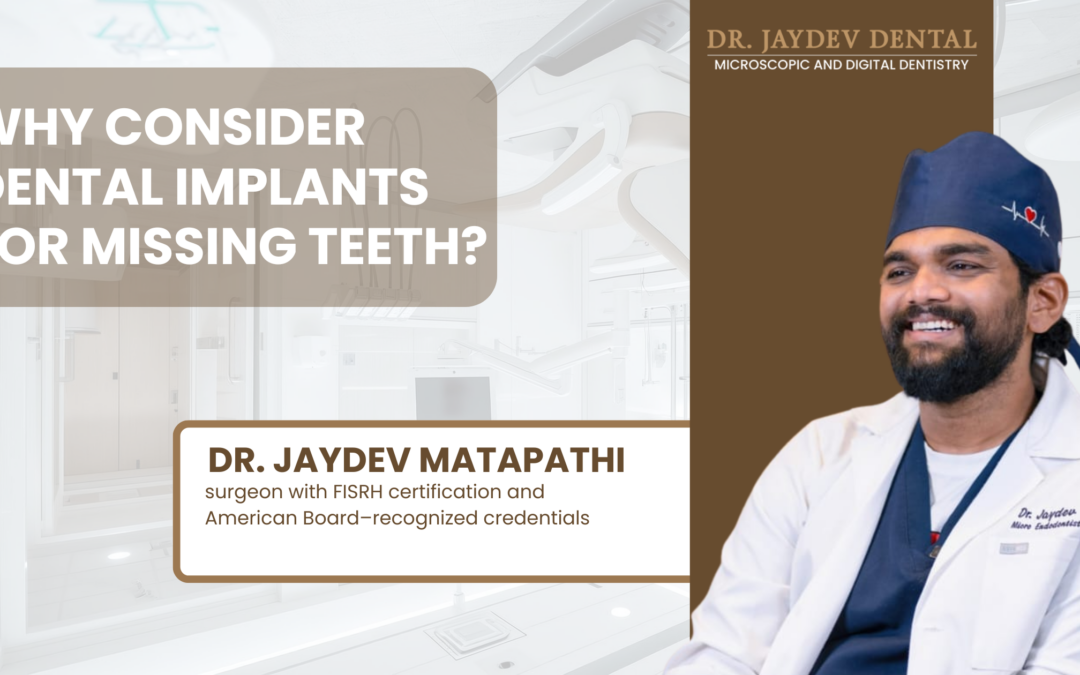
According to Dr. Jaydev, highly experienced in dental implants in Hyderabad, every other tooth replacement option addresses what is visible above the gum, but only an implant restores the root and prevents the jawbone resorption that follows extraction.
What Makes Dental Implants Clinically Superior to Other Tooth Replacement Options?
Dentures and bridges remain viable solutions for some patients. However, neither addresses the underlying biological consequence of tooth loss. Understanding the structural difference explains why implants consistently outperform alternatives in long-term outcomes.
- Implants integrate with the jawbone: The titanium post undergoes osseointegration, fusing directly with surrounding bone tissue. This creates a biomechanically stable foundation that transmits chewing forces to the jaw the same way a natural root does
- Bone resorption is halted: Without a root stimulating the bone, the alveolar ridge shrinks by approximately 25 percent in width within the first year of tooth loss. An implant placed promptly prevents this irreversible bone loss
- Adjacent teeth are not compromised: A conventional bridge requires grinding down healthy teeth on either side of the gap to support the prosthetic. Implants are entirely self-supporting and leave neighbouring teeth untouched
- Dentures accelerate bone loss: Removable dentures sit on top of the gum and provide no stimulation to the underlying bone. Bone loss continues under dentures and progressively reduces the fit, requiring relining over time
- Implants do not decay: The titanium post and ceramic crown are not susceptible to cavities. With proper oral hygiene, the implant itself requires no restorative intervention
- Bite force restoration is near-complete: Implant-supported crowns restore approximately 80 to 90 percent of natural bite force compared to dentures which restore roughly 20 to 25 percent
- Longevity is superior: With consistent oral hygiene and regular professional review, a well-placed implant can last several decades. Bridges typically require replacement within 10 to 15 years
When an entire arch requires restoration, full mouth dental implants deliver fixed function and address the progressive bone loss that conventional dentures cannot prevent.
Unsure whether a dental implant, bridge or denture is the right option for your case?
Who Is a Suitable Candidate for Dental Implants and What Conditions Require Attention First?
Implant candidacy is assessed across multiple clinical parameters. Most healthy adults with a missing tooth are eligible. Certain systemic and local conditions require management before placement but do not permanently exclude implant treatment.
- Adequate bone volume is the primary requirement: The implant post needs sufficient bone height and width to achieve stable osseointegration. Patients with significant bone loss may require a bone graft procedure before implant placement
- Gum disease must be treated first: Active periodontal disease creates a hostile environment for osseointegration. Scaling, root planing, and gum health stabilisation are completed before any implant is placed
- Controlled diabetes does not exclude implant treatment: Patients with well-managed blood glucose levels demonstrate implant success rates comparable to non-diabetic patients. Poorly controlled diabetes impairs healing and increases infection risk
- Smoking significantly affects success rates: Nicotine reduces blood supply to healing tissues and increases peri-implant infection risk. Cessation before and after implant placement substantially improves outcomes
- Autoimmune conditions and osteoporosis require evaluation: These conditions affect bone quality and immune response. Treatment planning accounts for medication history, particularly bisphosphonates, before surgery proceeds
- Age is not a contraindication in adults: Implants are placed once jaw growth is complete, typically after age 18. There is no upper age limit provided bone and systemic health support the procedure
- Single missing tooth cases are ideal for early intervention: Delaying replacement allows adjacent teeth to drift and bone loss to progress, complicating the procedure and increasing treatment cost
Where bone health and extraction conditions are favourable, 24-hour dental implants complete both placement and temporary restoration in a single appointment, significantly reducing the overall treatment timeline.
What Are the Long-Term Responsibilities of Caring for a Dental Implant?
An implant is a permanent investment. Its longevity is directly proportional to how well the surrounding tissue and oral environment are maintained. Implant failure is not inevitable but it is preventable.
- Brush twice daily around the implant crown: Plaque accumulation at the gum margin around an implant leads to peri-implantitis, an infection of the tissue surrounding the implant post that can cause progressive bone loss
- Floss or use interdental brushes daily: Standard floss and water flossers are both effective for cleaning the interproximal areas around the implant crown where a toothbrush cannot reach
- Schedule professional cleaning every 6 months: A hygienist uses implant-safe instruments to clean below the gum margin around the post without damaging the titanium surface
- Avoid biting on extremely hard objects: Implant crowns are ceramic and can fracture under sudden point loads from ice, unpopped kernels, or hard sweets. The implant post itself is durable but the crown carries standard ceramic limitations
- Wear a night guard if bruxism is present: Grinding exerts destructive lateral forces on implant crowns and the bone-implant interface. A custom occlusal splint protects both the restoration and the underlying osseointegration
- Report any mobility, pain, or gum changes immediately: A well-integrated implant has zero mobility. Any movement, persistent discomfort, or gum recession around the implant requires urgent clinical assessment
- Annual radiographic review is recommended: X-rays at yearly intervals allow the treating dentist to monitor crestal bone levels around the implant and detect early signs of peri-implant bone loss before it becomes clinically significant
To understand what can go wrong without proper maintenance and monitoring, read about failed dental implant due to bone loss and the solutions available when osseointegration is compromised.
Why Choose Dr. Jaydev Dental Clinic for Dental Implants in Hyderabad?
Dr. Jaydev holds an MDS in Conservative Dentistry and Endodontics with dual qualifications from the Royal College of Surgeons Ireland and the Royal College of Physicians and Surgeons Glasgow. He is a three-time IACDE Clinical Excellence Award recipient with dual super-specialisation in Microscopic Endodontics and Smile Designing.
Implants placed with proper pre-surgical planning and structured follow-up last decades. Most complications that bring patients in for corrective work trace back to cases where that planning was skipped.
References
Concerned about bone loss from a tooth you have had missing for months or years?
Get Every Single Answer About The Treatment
How long does the dental implant procedure take from placement to final crown?
The full process typically takes 3 to 6 months. Osseointegration requires 8 to 12 weeks before the permanent crown is placed. Single-sitting cases with same-day crowns are available for eligible patients.
Is the dental implant procedure painful?
The procedure is performed under local anaesthesia. Post-operative discomfort lasts 2 to 4 days and is managed with prescribed pain relief. Most patients describe it as less uncomfortable than a tooth extraction.
Can an implant be placed immediately after tooth extraction?
In suitable cases where bone is healthy and infection-free, immediate implant placement following extraction is possible. This reduces total treatment time and preserves the existing bone volume.
What happens if I do not replace a missing tooth?
Jawbone resorption begins within weeks of tooth loss. Adjacent teeth drift toward the gap, bite alignment changes, and the risk of further tooth loss increases progressively the longer the gap remains untreated.
How much does a dental implant cost in Hyderabad?
Implant cost varies based on bone condition, implant type, and crown material. A detailed cost breakdown is provided after a clinical examination and CBCT scan at the consultation.