Laser dentistry uses focused light beams, called photons, instead of drills or scalpels to perform precise dental procedures. It’s a minimally invasive option for both hard tissue (teeth) and soft tissue (gums), offering less pain, reduced bleeding, faster healing, and lower infection risk. Common applications include treating gum disease, gingivectomy, removing tooth decay, and frenectomies.
Laser dentistry has changed how we treat patients. No numb lips, no sutures, no drill anxiety. As a dentist in Hyderabad, my goal is preserving healthy tooth and gum tissue, and lasers let us do that with precision no manual instrument can match.
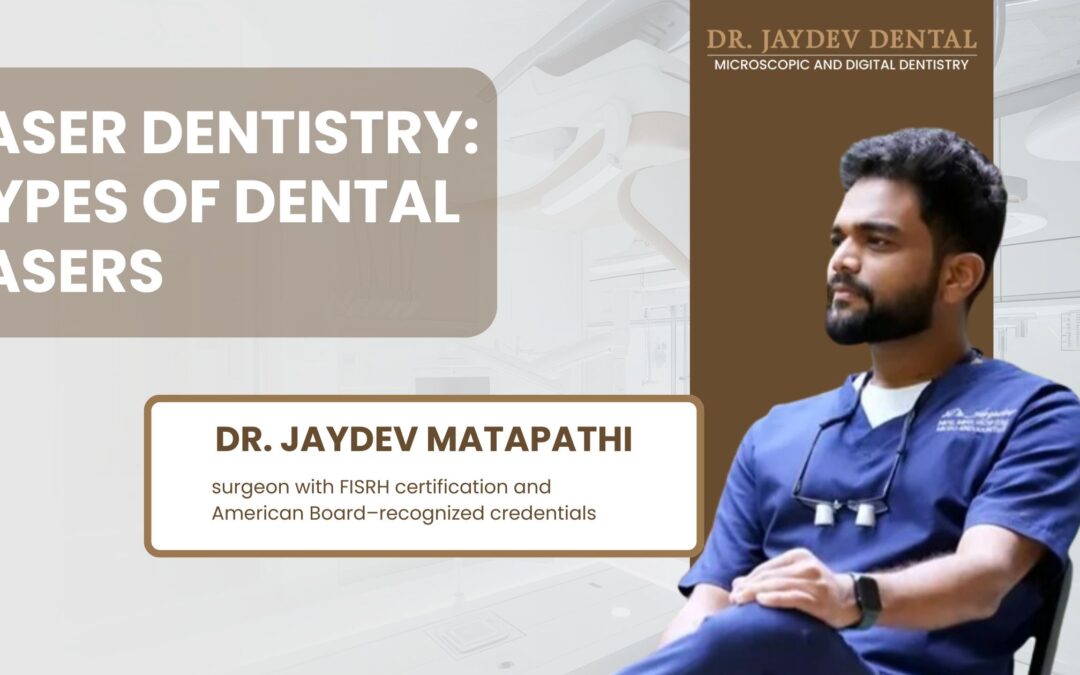
Dr. Jaydev Matapathi, Founder & Chief Dental Surgeon, Dr. Jaydev Dental Clinic
At our Jubilee Hills clinic, lasers aren’t a premium add-on, they’re part of daily practice. The FDA has cleared close to 20 laser applications for clinical dental use since the 1990s, and laser-based care protects healthy tooth structure while cutting down on the chemistry involved in traditional procedures.
What is Laser dentistry?

Laser dentistry is a minimally invasive type of dental care that directs focused photons of light energy to cut, shape, or clean hard and soft tissues inside the mouth. LASER stands for Light Amplification by Stimulated Emission of Radiation, and in our field that beam replaces scalpels, drills, and sometimes the anaesthetic shot too.
The mechanism? Fairly simple. When photons hit tissue, the energy gets absorbed by water, pigment, or mineral content, which then vaporises or reshapes the target, no pressure, no vibration, no heat spreading sideways. Bleeding stays minimal, swelling is rare, healing kicks off almost immediately. Traditional dentistry cuts mechanically, which traumatises nearby tissue and leaves wounds to seal on their own.
You’ll see lasers used across a wide spread of procedures now, from gum reconstruction and periodontal pocket cleaning to cavity prep, root canal disinfection, and cosmetic whitening. Been putting off treatment because the thought of the drill keeps you up at night? Laser dentistry is the more comfortable, more conservative route.
If you are having any dental or oral pains or discomforts but afraid to opt for the painful and time taking procedures, laser dentistry is the best option.
Types of Laser procedures
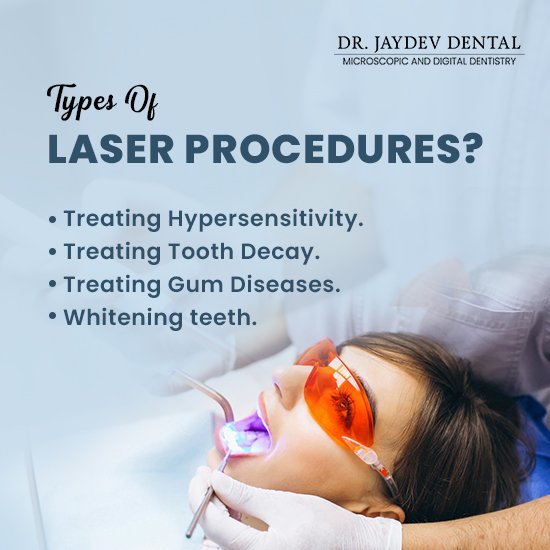
Every laser application in dentistry falls into one of two buckets, hard tissue or soft tissue. Hard tissue means teeth and bone. Soft tissue means gums, cheeks, tongue, and the lining of the mouth. Each category runs on a different wavelength because the target material absorbs light differently.
Common procedures handled with lasers include:
- Treating tooth hypersensitivity
- Cavity detection and removal
- Gum disease therapy and periodontal pocket cleaning
- In-office teeth whitening
Tired of drills, needles, and long recovery?
Hard Tissue Laser Procedures:
Hard tissue lasers are tuned to wavelengths that interact with calcium phosphate and the water content inside enamel and dentin. That selective absorption is what lets the laser remove decay without touching the healthy tooth around it, something a rotary drill simply can’t promise. Most hard tissue work happens without anaesthesia, and the pulp doesn’t overheat when the operator knows what they’re doing.
The main purpose of using hard tissue lasers:
Detecting Cavities: The beam travels into enamel and dentin, picks up early signs of tooth decay, flags demineralisation long before a cavity shows up on X-ray.
Dealing with tooth sensitivity: Sensitivity comes from open tubules in the root surface. The laser seals those tubules in seconds, and patients usually feel relief the same day.
Preparing teeth for dental fillings: The laser clears out decayed tissue, sterilises the cavity by killing residual bacteria, and leaves a clean surface for the filling material to bond to.
Soft Tissue Laser Procedures
FDA has cleared diode, carbon dioxide, and Nd:YAG lasers for soft tissue work. These are the workhorses for anything involving gums or oral mucosa. The laser cauterises while cutting, so bleeding during surgery is minimal, sutures are often unnecessary, and post-op swelling is noticeably less than with a scalpel.
Procedures in this bucket include gum reshaping, crown lengthening, gum reduction, and release of tight oral muscles like a tongue-tie.
The main purpose of using soft tissue lasers:
Treating gummy smile: Excess gum covering the teeth gets contoured back cleanly, and you walk out with a more balanced smile line in a single visit.
Crown lengthening: Before a tooth replacement or a crown, the laser reshapes gum and bone to expose enough healthy tooth structure for a stable restoration.
Treating tongue frenulum attachment: The frenulum is the small fold under the tongue. If it’s too tight, infants struggle to breastfeed and older children develop speech issues. A quick laser release fixes it.
Removing soft tissue folds: Soft tissue lasers remove folds caused by ill-fitted dental crowns or dentures rubbing against the cheek.
Preventing gum diseases: The laser reaches deep into periodontal pockets, clears out infected tissue, and kills the bacteria that standard scaling leaves behind.
What Laser Dentistry Can Treat?
- Root canal infections
- Gum disease and periodontitis
- Gum inflammation and swelling
- Oral biopsies
- Exposing impacted wisdom teeth
- Throat tissue reduction for sleep apnea
- Nerve regeneration after injury
- Removal of benign oral tumours
- Gum reshaping and contouring
- Canker sore and cold sore pain relief
- Canker sore and cold sore pain treatments.
Types of Lasers used in the Procedures
Not every laser does every job. At our Jubilee Hills clinic, we keep a set of lasers calibrated to different wavelengths, each sterilised and matched to the procedure at hand. Here’s what each type is good for.
Diode and Nd:YAG
Drawn to pigment and diseased tissue in the gums, which is exactly why they’re the standard choice for periodontal therapy. Diode lasers also pair well with bleaching agents during in-office whitening and speed up the reaction.
Carbon-Dioxide Lasers
CO2 lasers get absorbed strongly by water, making them efficient on soft tissue. They vaporise intracellular water in bacteria, which gives them strong sterilising action during gum work.
Erbium Lasers
The most versatile of the lot. Erbium wavelengths are absorbed by both water and apatite crystals, so the same machine handles soft tissue contouring and hard tissue work like cavity prep.
Argon Lasers
Argon emits a visible blue-green beam. It cures composite fillings quickly, performs near-bloodless soft tissue surgery, spots hairline cracks in enamel, and activates bleaching agents during teeth whitening.
Benefits of Laser Dentistry over Traditional Procedures
The advantages show up from the first appointment. Lasers seal blood vessels as they cut, which means little to no bleeding and faster clotting. Sutures are rarely needed for soft tissue work. The beam sterilises as it works, so infection risk drops sharply. Most patients skip anaesthesia for hard tissue procedures, no numb lip for three hours afterward. Healing runs 30 to 50 percent quicker than traditional surgery, and post-op pain is mild enough that over-the-counter medication handles it.
Benefits of Laser Dentistry over Traditional Procedures

Dr.Jaydev’s Note
Most of the tooth and gum problems I see in my chair are avoidable, and the ones that aren’t respond far better when we catch them early. If you’re holding off on treatment because the thought of a drill or scalpel is unbearable, that fear is valid, and it’s also solvable. Laser dentistry exists specifically for patients like you.
Come in, let our team look at what’s going on, and we’ll walk you through whether a laser-based approach fits your case. Give us a call or book the appointment directly through the website.
Curious if laser treatment is right for you?
1. When does one need to opt for Laser Dentistry?
Laser dentistry is recommended for active periodontal disease, deep gum pockets, bone loss around teeth, or loose teeth that conventional cleaning can’t fully treat.
2. What to expect during and after the procedure?
The steps mirror traditional dentistry, only the drill or scalpel is replaced by a laser beam. Patients report less soreness, faster healing, and a quicker return to normal eating.
3. How safe is laser for dental treatment?
Dental lasers are FDA-cleared, sterilised between patients, and calibrated to the target tissue. Infection risk is lower than scalpel-based work because the beam disinfects as it cuts.
4. Is Laser Dentistry Painful?
No. Laser dentistry is one of the most comfortable procedures in modern dental care, often needing no anaesthesia.
5. How laser dentistry help in smile beautification?
During teeth whitening, the laser activates the bleaching agent and lifts deep stains without damaging enamel, giving a brighter, more uniform shade.
Refrences
- U.S. Food and Drug Administration — Dental Devices: https://www.fda.gov/medical-devices/consumer-products/dental-devices
- American Dental Association — Lasers in Dentistry (Oral Health Topics): https://www.ada.org/resources/ada-library/oral-health-topics/lasers-in-dentistry