Endodontic surgery is a small operation that clears infection at the tip of a tooth’s root when a root canal alone didn’t settle it. Usually that means an apicoectomy. The surgeon takes off the very end of the root, clears the infected tissue around it, and seals the root from below. Local anaesthesia. Under an hour. Done. And often it’s the one thing standing between a tooth and extraction. A last resort, sure. But a good one.
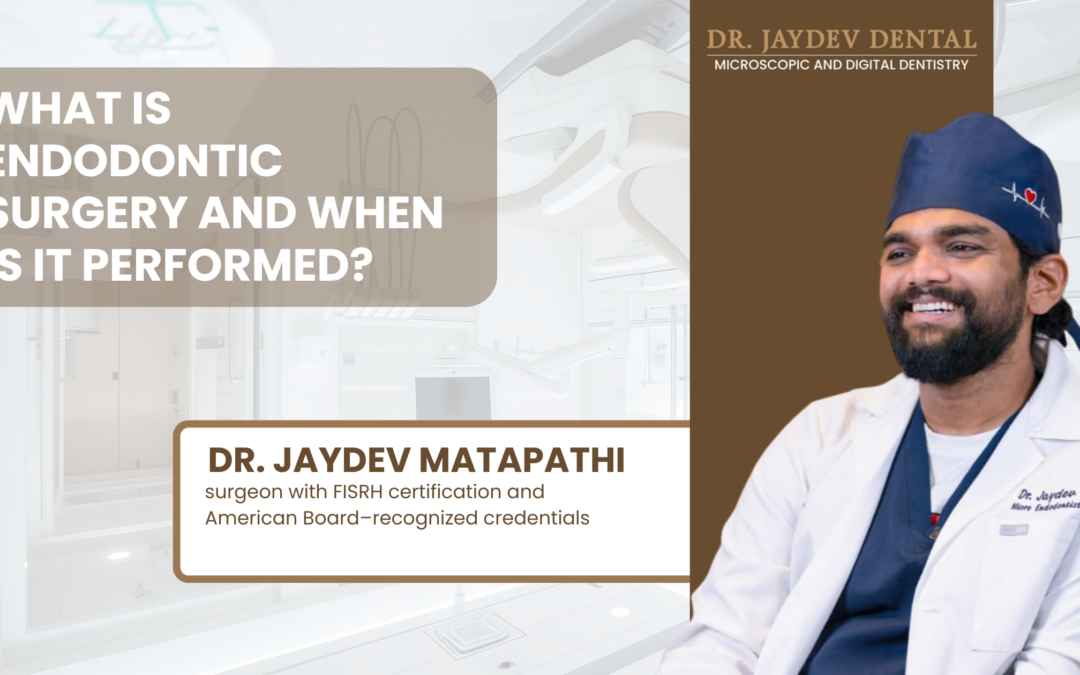
According to Dr. Jaydev, highly experienced in Endodontic Surgery in Hyderabad, we turn to surgery only after a root canal and a retreatment have had their chance, and even then it’s about keeping the tooth, not removing it.
Recurring pain at a root canal-treated tooth that just won’t settle?
What Happens During Endodontic Surgery?
It’s small, precise work. The surgeon reaches the root tip through the gum, not through the crown.
Access: A small cut in the gum opens the way to the bone and the infected root tip hiding beneath it.
Root-end removal: Off comes a few millimetres of the root apex, and the trapped bacteria leave with it.
Sealing: A tiny filling caps the cut root end. That’s what stops the infection sneaking back.
Healing: Gum gets stitched. Bone fills back in around the root over the next few months.
All of it under a microscope, millimetre by millimetre. If there’s still a non-surgical route, a re-root canal treatment gets tried first.
When Is Endodontic Surgery Needed?
It comes up for one of two reasons. The infection won’t clear through the canal, or the canal can’t be reached the normal way.
Persistent infection: The root tip stays infected even after a root canal and a redo. Surgery reaches what the canal couldn’t.
Blocked canals: A post, a crown, hardened filling. Anything sealing the canal pushes the surgeon to work from the root end instead.
Hidden cracks: Opening the gum lets the dentist look at the root directly and catch a fracture the X-ray glossed over.
Stubborn cysts: A cyst sitting at the root tip sometimes has to come out before the bone will heal.
And if the tooth can’t be saved even with surgery, removal is the honest answer. Before reaching that point, endodontic retreatment is always worth exploring first.
Why Choose Dr. Jaydev Dental ?
Dr. Jaydev trained in the UK and holds an MDS with dual qualifications from the Royal College of Surgeons in Ireland and Glasgow. Apical surgery under magnification is some of the most technically demanding work in dentistry, and his entire clinical training has been built around exactly this.
Most patients who reach the surgical stage have already been told the tooth is finished. A good number of them leave with it still in place. That’s what working under a microscope, by someone who does it every day, actually means.
Frequently Asked Questions
Is endodontic surgery painful?
No, local anaesthesia numbs the area, and most discomfort afterwards is mild.
How long does recovery take?
Most people feel fine within a few days, with bone healing over months.
Is endodontic surgery safe?
Yes, it’s a routine, low-risk procedure when done by a trained specialist.
Will I keep my tooth?
Usually yes, surgery is done specifically to save a tooth from extraction.