My Root Canal Still Hurts: When Is It Normal and When Is Retreatment Needed?
A root canal is supposed to end tooth pain so it can be unsettling when the tooth still aches days later. The good news? A little tenderness afterward is usually part of normal healing. The trick is knowing which aches settle on their own and which ones are the...
What causes Calculus? Removal and Preventive measures
Dental calculus is hardened plaque that forms when bacterial deposits on teeth aren’t cleared away and go on to mineralize. It starts as a soft, sticky film that thickens with sugar and starch residue, then pulls calcium and phosphate out of saliva until it sets...
Single-Tooth Implant vs. Dental Bridge: Which Wins?
A single tooth implant replaces a missing tooth with a titanium root placed into the jawbone, topped with a crown leaving adjacent teeth untouched. A bridge spans the gap by crowning the two neighbouring teeth and suspending a false tooth between them no surgery, but...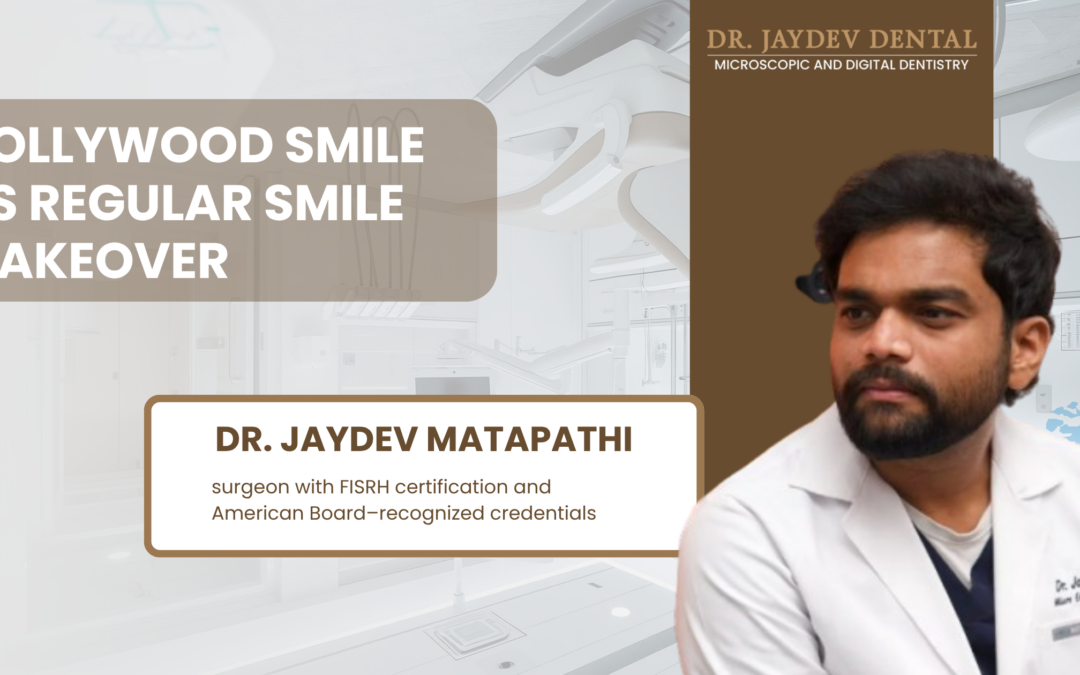
Hollywood Smile vs Regular Smile Makeover: What’s Actually Different?
A Hollywood smile delivers uniformly white, symmetrical teeth through full-arch porcelain veneers across 8 to 10 upper teeth. A regular smile makeover is problem-driven correcting gaps, chips, discolouration, or misalignment using whatever procedures fit the case....Medically Reviewed by

Dr. Jaydev Matapathi
BDS, MDS (Conservative Dentistry & Endodontics)
MFD RCSI (UK), MFDS RCPS (Glasgow, UK)
Member Faculty of Dentistry — Royal College of Surgeons, Ireland
Member Faculty of Dental Surgery — Royal College of Physicians and Surgeons, Glasgow Dual Super-Specialisation: Microscopic Endodontics & Smile Designing
Member Faculty of Dental Surgery — Royal College of Physicians and Surgeons, Glasgow Dual Super-Specialisation: Microscopic Endodontics & Smile Designing