Hollywood Smile vs Regular Smile Makeover: What’s Actually Different?
A Hollywood smile delivers uniformly white, symmetrical teeth through full-arch porcelain veneers across 8 to 10 upper teeth. A regular smile makeover is problem-driven correcting gaps, chips, discolouration, or misalignment using whatever procedures fit the case....
Dental Implant Failure: What Causes It and How to Recognise It Early?
Dental implant failure occurs when the implant loses integration with the bone or surrounding tissue breaks down after placement. Failure isn’t random. It has a traceable cause: infection, insufficient bone, bite overload, or neglected maintenance. Early failure...
Full Mouth Rehabilitation vs Multiple Individual Treatments: Which Makes More Clinical Sense?
Full mouth rehabilitation is a coordinated treatment plan that addresses structural, functional and aesthetic problems across all teeth at once. Individual treatments work when problems are isolated. But when multiple teeth are failing, the bite has collapsed, or old...
Microscopic Root Canal vs Regular Root Canal: Is the Extra Precision Worth It?
A microscopic root canal uses a dental operating microscope at 4x to 30x magnification, helping clinicians locate calcified canals, detect cracks, and remove infected tissue that standard instruments often miss. Regular root canals rely on tactile feel and X-rays,...
How Many Veneers Do You Actually Need for a Full Smile Makeover?
A full smile makeover typically requires 6 to 10 veneers to cover all teeth visible when smiling. The exact count depends on smile width, degree of discolouration or damage, and whether adjacent teeth need structural correction. Minor cases may need only 4 veneers,...Medically Reviewed by
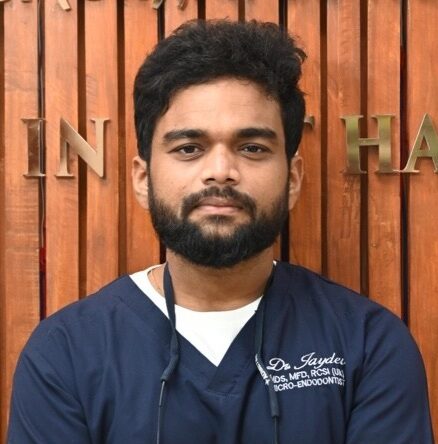
Dr. Jaydev Matapathi
BDS, MDS (Conservative Dentistry & Endodontics)
MFD RCSI (UK), MFDS RCPS (Glasgow, UK)
Member Faculty of Dentistry — Royal College of Surgeons, Ireland
Member Faculty of Dental Surgery — Royal College of Physicians and Surgeons, Glasgow Dual Super-Specialisation: Microscopic Endodontics & Smile Designing
Member Faculty of Dental Surgery — Royal College of Physicians and Surgeons, Glasgow Dual Super-Specialisation: Microscopic Endodontics & Smile Designing